
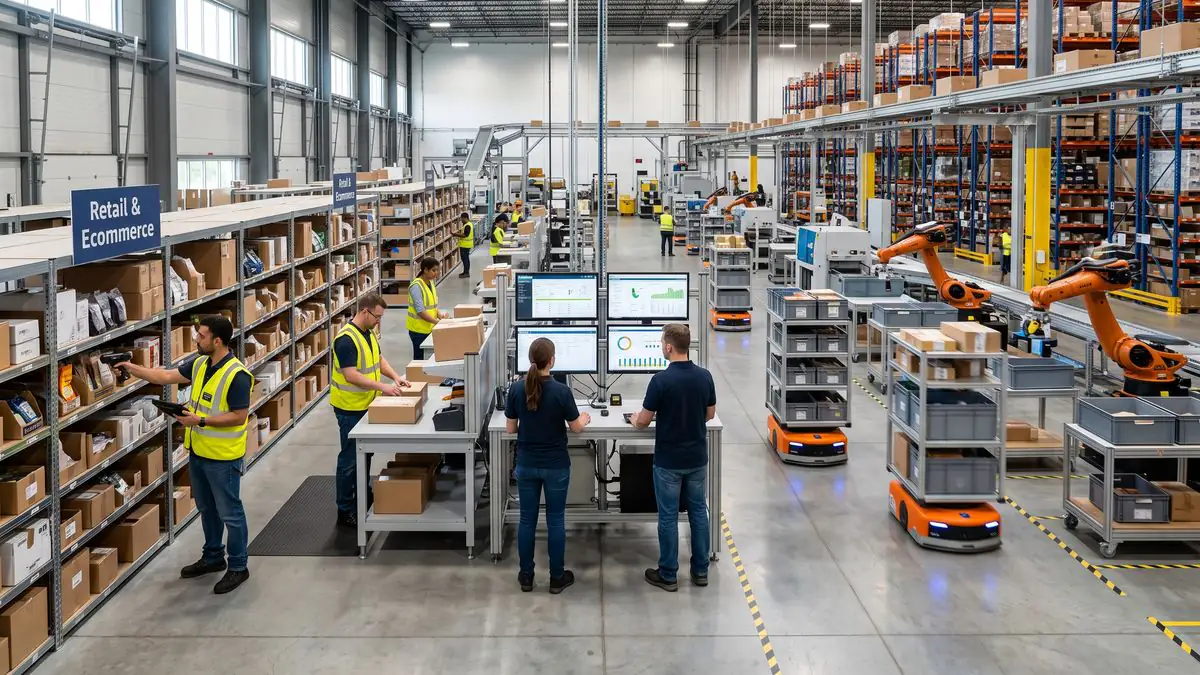
A warehouse can be busy without being efficient. Orders may arrive automatically, yet staff still decide where each order goes and chase exceptions by hand. Inventory may update in one system while another still shows yesterday’s numbers.
Warehouse automation software can remove some of that manual work, but choosing a platform is not as simple as finding the one with the longest feature list. Some systems focus on warehouse execution. Others connect fulfillment with the rest of a retail operation. Enterprise platforms may even coordinate people and robotics on the same warehouse floor.
The best warehouse automation software depends on the operation you need to automate. Brightpearl is well-suited to growing retail and ecommerce businesses that want warehouse workflows connected with wider retail operations. Specialist warehouse management system (WMS) platforms such as Manhattan Active WM and Blue Yonder address more complex distribution and robotics requirements.
What to know before comparing warehouse automation software
- There is no single best platform for every warehouse. A multichannel retailer, a third-party logistics provider (3PL), and a heavily automated distribution center have different requirements.
- Software automation does not necessarily require robots. Routing rules, barcode-led workflows, and inventory updates can remove manual work without adding physical automation.
- Implementation matters as much as functionality. A system has to work with your channels, warehouse processes, and existing technology.
- Compare the cost of the wider operation, not just the software subscription. Manual work, integration requirements, and implementation effort all affect the business case.
What is warehouse automation software?
Warehouse automation software uses digital systems to control or automate work inside the warehouse. That can include inventory movement and fulfillment, as well as the decisions that determine how orders move through the operation. It can work on its own or alongside physical automation. A WMS usually manages warehouse activity, while more advanced warehouse execution systems (WES) can coordinate work between people and automated equipment.
The term covers several types of technology, which is one reason software comparisons can become confusing. Blue Yonder defines warehouse automation as a combination of digital software and physical technology. At the software level, a warehouse management system can direct inventory and fulfillment tasks without requiring conveyors or robots.
A retailer looking to reduce manual order routing may therefore need a very different platform from a distribution center trying to coordinate several robotic systems.
That distinction should come before any ranking.
How we compared the best warehouse automation software
Rather than ranking unlike products from first to last, we assessed each platform according to the type of operation it is designed to support.
The comparison considers:
- Warehouse workflows: How the software handles inventory movement and order fulfillment.
- Automation depth: Whether it automates business rules, warehouse tasks, or physical equipment.
- Operational fit: The types of businesses and warehouse environments the platform targets.
- Connected operations: How warehouse activity works with orders, sales channels, and other business systems.
- Platform scope: Whether warehouse management is the product’s main focus or part of a wider operations platform.
The “best fit” labels below reflect those differences rather than claiming that one product is objectively better than every other option.
Best warehouse automation software compared
|
Software |
Best fit | Main automation focus |
Important consideration |
| Brightpearl | Growing retail and ecommerce businesses | Warehouse and fulfillment workflows connected with wider retail operations | Best suited to businesses that want warehouse activity tied to orders, inventory and financial workflows |
| Linnworks | Multichannel ecommerce operations | Warehouse workflows connected with inventory, listings and shipping | Strong fit when channel coordination is a major requirement |
| Cin7 | Small and midsize product businesses | Inventory-led warehouse automation and multi-location fulfillment | Warehouse management sits within a wider inventory management platform |
| ShipHero | direct-to-consumer (DTC) brands and 3PLs running their own warehouses | Ecommerce picking, shipping and warehouse routing | More warehouse-focused than a broader retail operations platform |
| Extensiv | Third-party logistics providers | Multi-client warehouse operations and 3PL billing | Its strongest use case is specialized 3PL management |
| NetSuite WMS | Businesses already operating in NetSuite | Warehouse execution connected with NetSuite business applications | WMS is an add-on module within the wider NetSuite environment |
| Manhattan Active WM | Complex enterprise distribution centers | Labor, automation, and robotics orchestration | Greater depth can also mean a larger implementation scope |
| Blue Yonder | Highly automated warehouse networks | Warehouse execution and multi-vendor robotics coordination | Most relevant when advanced warehouse execution is a primary requirement |
1. Brightpearl: For connected retail and ecommerce operations
Brightpearl takes a wider view of warehouse automation than a standalone WMS. It is a Retail Operating System built for retail and ecommerce businesses, so warehouse activity can remain connected with the processes that happen before and after fulfillment.
Its Automation Engine can allocate inventory according to predefined rules and route orders to a warehouse or 3PL. Retailers can also automate partial shipping logic and flag exceptions when an order cannot follow its normal path.
Inside the warehouse, Brightpearl supports barcode-led workflows across receiving and fulfillment. Its current warehouse management functionality includes scanning for inventory movements as well as support for serial, lot, and expiration tracking.
This makes Brightpearl particularly relevant when the warehouse is one part of a larger retail operations problem. For example, an omnichannel retailer may want an order to enter from a sales channel, allocate against available inventory, and reach the appropriate fulfillment location without staff moving data between separate systems.
Brightpearl is less likely to be the comparison starting point when the main requirement is controlling fleets of warehouse robots. Businesses at that level should also evaluate specialist WMS and WES platforms designed around physical automation.
Best fit: Retail and ecommerce businesses that want warehouse automation connected to the rest of their operations.
2. Linnworks: For multichannel ecommerce warehouses
Linnworks combines warehouse management with multichannel commerce operations. Its warehouse functionality includes digital picklists, barcode scanning, and warehouse configuration using zones and bins. It also connects warehouse activity with inventory, listings, and shipping.
That relationship with sales channels is an important distinction. A retailer selling through several marketplaces needs more than an efficient picking process if inventory information becomes inconsistent between the warehouse and the places where customers buy.
Linnworks updates connected inventory as transactions occur and uses warehouse workflows to support order fulfillment. Its shipping tools can also apply rules to carrier selection.
For businesses comparing Linnworks with Brightpearl, the decision is likely to extend beyond warehouse functionality. Teams should examine how each platform fits their order lifecycle and which wider retail processes they want the same system to own.
Best fit: Multichannel ecommerce businesses where warehouse management and channel coordination need to work closely together.
3. Cin7: For inventory-led warehouse operations
Cin7 approaches warehouse management from an inventory management foundation. Its current warehouse capabilities include real-time stock visibility, barcode scanning, and order routing based on inventory location. The company positions its warehouse functionality for ecommerce, retail, and wholesale businesses, including small and midsize companies.
This can make Cin7 attractive when inventory coordination is the main operational concern.
For a business holding stock across several locations, Cin7 can route orders based on available inventory while keeping warehouse data connected to the wider inventory system. Cin7 also supports businesses that work with external fulfillment partners via 3PL connections.
Buyers should look closely at which Cin7 product and configuration matches their requirements. Cin7 currently distinguishes between Core, which it positions toward smaller businesses, and Omni for operations with more advanced requirements.
Best fit: Product businesses that want warehouse workflows closely tied to inventory management across multiple locations.
4. ShipHero: For DTC brands and ecommerce fulfillment teams
ShipHero is a warehouse-first option built for DTC brands and 3PL providers that run their own fulfillment operations. Its WMS supports warehouse inventory, order processing, and shipping from the same environment.
Automation rules can act when orders enter the system, and ShipHero also supports rules that run after multi-warehouse allocation. Its multi-warehouse functionality lets businesses determine where ordered inventory should be allocated and manage transfers between facilities.
ShipHero also puts substantial emphasis on ecommerce shipping. Its 3PL offering includes warehouse routing, automation rules, and shipping rate comparison tools.
That makes it a strong candidate when the fulfillment center itself is the focus of the software decision. Businesses that need deeper accounting, purchasing, or retail-wide operational management may want to compare how ShipHero connects with those systems rather than judging it only on warehouse functionality.
Best fit: DTC brands and ecommerce fulfillment operations that want a dedicated WMS with strong shipping functionality.
5. Extensiv: A specialist option for third-party logistics providers
A warehouse serving its own retail business has different requirements from a 3PL managing inventory and orders for many customers.
Extensiv addresses that distinction directly. Its 3PL Warehouse Manager is built around third-party logistics operations and supports daily warehouse activity from receiving through shipping. It also includes customer-facing functionality such as portals and automated notifications.
One of its more distinctive areas is billing. Extensiv can connect warehouse events to client charges, enabling 3PLs to automate parts of the billing process rather than manually reconstructing billable activity at the end of a period.
That specialization matters. Features designed for a multi-client logistics business may be unnecessary for a retailer operating its own warehouse, but they can be central to a 3PL’s business model.
Best fit: 3PL businesses that need warehouse operations and client billing handled within a system designed for multi-client fulfillment.
6. NetSuite WMS: For businesses already using NetSuite
NetSuite WMS is an add-on module within the wider NetSuite suite, making it particularly relevant to businesses already using NetSuite for other operations.
The system supports mobile receiving and putaway as well as guided picking. It also includes wave release, bin management, and cycle counting. Because WMS is part of the broader NetSuite suite, warehouse operations can integrate with NetSuite inventory management and order fulfillment.
That architecture is its clearest advantage for existing NetSuite customers.
For companies that are not already invested in NetSuite, however, the buying decision becomes much larger than choosing warehouse software. NetSuite states that WMS is an add-on module and that its licensing model includes the core platform, selected modules, and users, along with an initial implementation cost.
Best fit: Businesses using NetSuite that want warehouse management to remain within the same application suite.
7. Manhattan Active WM: For complex enterprise distribution
Manhattan Active Warehouse Management operates at a different level of warehouse complexity from many retail-focused platforms in this comparison.
The cloud-based WMS is designed to coordinate inventory, labor, and automation. It also includes warehouse execution functionality that can coordinate work involving robotics and other forms of automated material handling.
That makes Manhattan relevant to large distribution operations where the software has to do more than automate order rules or guide a picker through a warehouse. It can become part of the control layer coordinating work across people and automated equipment.
The tradeoff is fit. A growing ecommerce retailer should not assume it needs enterprise warehouse execution simply because those capabilities are more advanced. Implementation scope should reflect the complexity of the operation being managed.
Best fit: Large or complex distribution operations that need warehouse management and execution across human and automated resources.
8. Blue Yonder: For advanced warehouse and robotics coordination
Blue Yonder is another enterprise option, but its Robotics Hub gives it a particularly clear role in warehouses using physical automation from multiple vendors.
Its warehouse platform covers core WMS functions alongside resource orchestration, warehouse execution, and advanced slotting. The Robotics Hub provides a vendor-neutral layer to connect different warehouse robotics systems to the WMS.
This addresses a problem that many retail-focused automation platforms are not trying to solve: how to coordinate warehouse software with several types of automated equipment while maintaining a central view of the operation.
For a retailer whose biggest problems are manual order routing or disconnected inventory data, that level of functionality may exceed the business’s needs. For a heavily automated distribution network, it may be exactly the capability under evaluation.
Best fit: Enterprise warehouses that need WMS functionality alongside advanced warehouse execution and robotics coordination.
How to choose warehouse automation software
The product comparison should narrow your options, but the final decision should start inside your own warehouse.
Identify the Process That Is Actually Causing the Problem
Do not begin by asking how much automation you can buy.
Start with the point where work slows down or becomes unreliable. If staff repeatedly decide which warehouse should fulfill each ecommerce order, rules-based order routing may have more immediate value than physical automation.
If the problem is excessive picker travel across a large facility, software alone may not solve it.
Those are different problems and should lead to different technology decisions.
Decide How Much of the Operation the Platform Should Own
A dedicated WMS can make sense when the warehouse requires specialist functionality and other business systems already work well.
A broader retail platform may make more sense when the main issue is the handoff between the warehouse and the rest of the operation.
For retail and ecommerce teams, that means looking beyond what happens between receiving and shipping. Consider what happens to the order before it enters the warehouse and what needs to be updated after fulfillment.
Test Exceptions, Not Just the Ideal Workflow
Software demonstrations often show the easiest version of an order.
Ask vendors to show what happens when something goes wrong instead.
For example:
- What happens when the expected inventory is not available?
- Can an order move to another fulfillment location without manual re-entry?
- How does the system handle a partial shipment?
- Who sees the exception, and what action can they take?
Automation saves time when ordinary orders no longer need attention. Poor exception handling can give that time straight back.
Compare Implementation Scope as Well as Functionality
Two products with similar warehouse capabilities can require very different implementations.
Find out what needs to change before launch. Ask how sales channels and existing systems will connect. The implementation plan should also explain how warehouse employees will learn new workflows.
This is particularly important when comparing a focused WMS with an enterprise platform or a wider Retail Operating System.
Evaluate the Cost of the Process, Not Only the Software
Subscription price is only one part of the calculation.
Consider whether the new system removes existing software costs or introduces new ones. Look at how much manual work remains after implementation and whether integrations require ongoing maintenance.
A more expensive platform can make economic sense if it removes enough operational costs. A cheaper one can become expensive if teams keep filling gaps manually.
When warehouse automation software is not enough
Software can decide what should happen and direct work more efficiently. It cannot remove all physical constraints within a warehouse.
If the main bottleneck comes from long travel distances, limited storage density, or the physical movement of high order volumes, the business may need to investigate equipment such as automated storage systems or mobile robotics alongside its software.
This is where the distinction between WMS and WES becomes important. Manhattan explains that a WMS focuses on inventory and warehouse processes, while warehouse execution adds coordination across automated resources. Blue Yonder similarly combines warehouse management with execution and robotics capabilities for more automated environments.
Buying more software will not correct a physical bottleneck simply because the product carries an automation label.
Where Brightpearl fits
For growing retailers, the most valuable warehouse automation may happen before a picker ever touches an item.
An order has to reach the right fulfillment location. Inventory needs to reflect what is actually available. Exceptions must reach the people who can resolve them, and the rest of the operation needs accurate information once fulfillment occurs.
Brightpearl brings those workflows into its Retail Operating System. Its Automation Engine can apply order and inventory rules across warehouses and 3PLs, while its warehouse management functionality supports the physical fulfillment process with barcode-led workflows.
That makes Brightpearl a strong candidate when warehouse automation is part of a wider retail operations problem rather than an isolated distribution-center project.
If your business needs warehouse workflows connected with order management, inventory, and financial operations, book a Brightpearl demo to see how those processes can work together.
Warehouse automation software buying FAQs
What data should be cleaned before implementing warehouse automation software?
Start with the data the warehouse relies on to make decisions. Inventory records should accurately reflect what is on hand and where it is stored. Product identifiers and barcode information also need to match the items employees handle on the warehouse floor.
Automating decisions based on unreliable inventory data can make an existing problem happen faster rather than fixing it.
Which warehouse KPIs should you track after implementation?
Choose measurements that relate directly to the problem the software was purchased to address.
If picking errors drove the investment, measure order accuracy before and after implementation. If labor capacity was the concern, compare the amount of work required per order or the number of orders the warehouse can process during the same period.
Avoid treating a large dashboard as proof that automation is working. The useful metric is the one connected to the original business case.
Can warehouse automation software connect with robots later?
Some platforms can, but the level of support varies widely.
Enterprise systems such as Manhattan Active WM include warehouse execution capabilities for coordinating automation, while Blue Yonder offers a Robotics Hub designed to connect multiple robotics vendors with its warehouse management environment.
If physical automation is part of your future plan, ask vendors about supported equipment and integration architecture before choosing the WMS.
Does warehouse automation always reduce headcount?
No. Automating a process can reduce the manual work required for that process, but it does not guarantee a matching reduction in total warehouse staffing.
Employees may spend less time on routine order handling and more time managing exceptions or other work that still requires human judgment. Build the business case around specific tasks and operating costs rather than assuming a fixed reduction in headcount.
Should a growing retailer choose a WMS or a broader retail platform?
It depends on where operational complexity sits.
A specialist WMS can be the better choice when warehouse execution itself requires deeper functionality. A broader retail platform can make more sense when warehouse problems are closely connected with order management, inventory, sales channels or financial workflows.
The best warehouse automation software is the one that addresses the operation you actually have without requiring complexity you do not need.


