
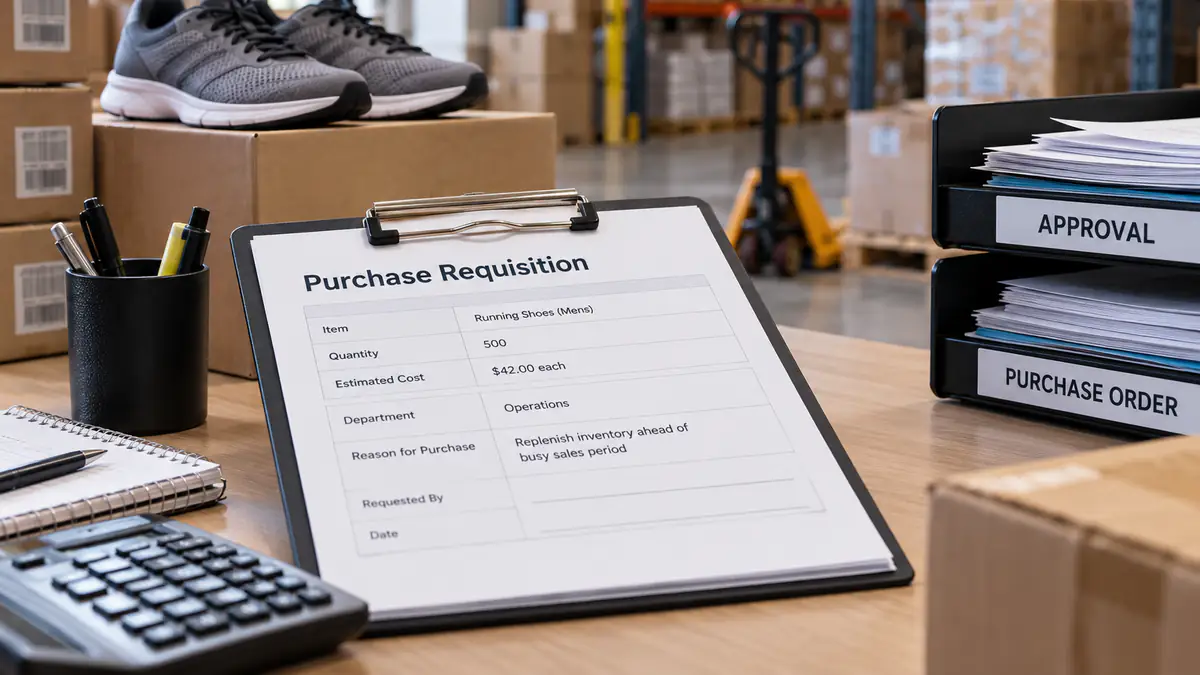
A retailer sees stock running lower than expected ahead of a busy sales period. The purchasing team knows that more inventory is needed, but before placing an order with the supplier, the business may want to confirm the quantity, expected cost, and budget.
That is where a purchase requisition can come in.
A purchase requisition is an internal request to approve a proposed purchase before the business places an order with a supplier. It records what is needed, why the purchase is being requested, and other information required for approval. Once approved, the request may be used to create a purchase order.
Purchase requisitions can provide finance, purchasing, and operations teams with greater visibility into planned spending. They are not required for every purchase or every business, however. The right process depends on the value and risk of the purchase and the controls the company already has in place.
Key takeaways
- A purchase requisition is an internal request for approval, while a purchase order is an external document used to place an order with a supplier.
- Businesses can use requisitions to review planned purchases before committing money and create a record of who requested and approved them.
- The purchase requisition process should match the purchase. A routine order may not need the same approval path as an unbudgeted or higher-value purchase.
- For retailers, the need to buy may start with inventory planning, sales demand, or stock levels rather than with the requisition itself.
- Connected purchasing, inventory, and financial systems can reduce manual handoffs and give teams clearer visibility as order volumes and purchasing activity grow.
What is a purchase requisition?
A purchase requisition is a document or digital request used within a business to request authorization to purchase goods or services.
It does not place an order with a supplier. Instead, it gives the appropriate people a chance to review the proposed purchase before the company makes an external commitment.
A requisition may include details such as:
- The item or service being requested
- Quantity and expected cost
- The department or person making the request
- The reason for the purchase
- A preferred or approved supplier
- The budget or account to which the purchase should be charged
- When the goods or services are needed
The exact information will vary between businesses. The aim is to provide the person reviewing the request with enough information to decide whether the purchase should proceed without turning the form into unnecessary paperwork.
How do purchase requisitions work?
Where a business uses formal purchase requisitions, the process usually happens before a purchase order is sent to a supplier.
1. A purchasing need is identified
Someone first identifies a need for goods or services.
For an office purchase, this may start with an employee or department requesting equipment or outside services.
Retail inventory purchasing can begin differently. A buyer may recognize the need from stock levels, sales forecasts, seasonal demand, or replenishment planning. In that case, the requisition does not create the purchasing need. It gives the business a point at which to review that need before placing the order.
2. The requester creates the requisition
The requester enters the information needed to evaluate the purchase.
A complete request can reduce the need for follow-up questions. At the same time, requiring information that has no bearing on the approval decision can make the process slower.
Businesses need to decide which information matters for each type of purchase.
3. The request goes to the appropriate approver
The requisition may be routed to a manager, purchasing team, or finance team, depending on how the business assigns purchasing authority.
Approval rules can also vary based on factors such as purchase amount, department, budget, or supplier.
A lower-value purchase from an approved supplier may need little intervention. A large unbudgeted purchase or a request involving a new supplier may justify additional review.
4. The request is approved, rejected, or returned
The approver decides whether the proposed purchase can proceed.
They may approve it, reject it, or return the request because more information is needed. Clear approval rules can also reduce unnecessary routing between people who have no distinct decision to make.
5. An approved request may become a purchase order
Once the requisition has been approved, the purchasing team can use the approved information to prepare a purchase order.
The purchase order is the document sent to the supplier. It confirms what the business wants to buy and sets out details such as quantities, agreed prices, and delivery terms.
The requisition and purchase order serve different purposes even when they contain some of the same information.
6. Purchasing continues through receipt and invoicing
After the supplier receives the purchase order, the transaction moves into the rest of the purchasing process.
The business receives the goods or services and processes the supplier invoice in accordance with its financial controls.
The requisition remains part of the internal record showing how the purchase was originally requested and authorized.
Purchase requisition vs. purchase order: What’s the difference?
Purchase requisitions and purchase orders are closely connected, but they are not interchangeable.
|
Purchase requisition |
Purchase order |
|
| Purpose | Request internal approval to make a purchase | Place an approved order with a supplier |
| Used by | Employees, managers, purchasing, and finance teams | The buyer and supplier |
| Sent to the supplier? | No | Yes |
| When it appears | Before the external purchase commitment | After the business has decided to place the order |
| Main role | Authorization and internal documentation | Confirming the goods or services being ordered |
Not every purchase order has to begin with a separate requisition. Businesses may use other authorized purchasing methods for recurring, pre-approved, or lower-risk transactions.
The distinction matters because adding a requisition makes the most sense when an internal decision must be made before the supplier receives an order.
Why do businesses use purchase requisitions?
Purchase requisitions can give businesses greater control over purchasing before money is committed.
Review spending before the order is placed
A requisition can give finance or another approver a chance to review planned spending before an order is placed.
The business can confirm whether the purchase has been authorized and whether the appropriate budget is available before moving forward.
Give purchasing teams visibility into upcoming demand
A central record of purchase requests can help purchasing and finance teams see what different departments plan to buy.
For retailers, this visibility can also help connect purchasing decisions with inventory needs rather than treating stock orders and financial planning as separate activities.
Create a record of purchasing decisions
A requisition can document who requested a purchase, what was requested, and who approved it.
That record can support internal controls and make it easier to understand how a purchasing decision was made later.
A requisition alone does not prevent fraud or purchasing errors. Supplier controls, receiving processes, invoice checks, and other financial controls continue to play distinct roles.
Apply different controls to different purchases
Not every transaction carries the same cost or risk.
A business can set approval rules so routine purchases move through a simpler process, while unusual, higher-value, or unbudgeted requests receive more scrutiny.
This can help preserve oversight without requiring every purchase to pass through the same number of people.
When can purchase requisitions become a problem?
The same process intended to control spending can create delays if it includes unnecessary steps.
For example, requiring several people to approve a routine purchase may add work without changing the decision. Long forms can create the same problem when requesters have to provide information that nobody uses.
Frequent workarounds or exceptions can indicate that the standard purchasing process is too difficult or slow for the transactions moving through it.
Businesses should therefore look at the value each approval adds rather than measuring control by the number of steps in the process.
Signs that a purchase requisition process may need attention include repeated requests for missing information, approvers routinely signing off without meaningful review, and frequent exceptions to the normal purchasing process.
The goal is not to remove oversight. It is to make sure each control has a clear purpose.
Do all purchases need a purchase requisition?
No. A purchase requisition is one way to manage purchasing authorization, not a universal requirement.
Some businesses may use them extensively. Others may rely on different controls for certain types of purchasing, such as approved purchasing limits, existing contracts, recurring orders, or purchase order approval.
Retailers may also automate parts of inventory replenishment according to predefined rules.
This makes one question especially useful when deciding whether a requisition belongs in a workflow:
What decision still needs to be made before this purchase can go ahead?
If someone needs to confirm the budget, approve a new supplier, or authorize an unusual level of spending, a requisition can provide a useful checkpoint.
If those decisions have already been made under established purchasing rules, another approval stage may duplicate work.
How purchase requisitions fit into retail purchasing
Generic purchase requisition examples often begin with an employee asking to buy something. Retail purchasing can start much earlier.
Inventory levels may fall below a planned threshold. Sales data may indicate that demand is increasing. A seasonal buying plan may call for stock to arrive before a set date.
The business first needs to determine what should be purchased and how much. The requisition, where one is required, addresses a different question: should this proposed purchase be authorized?
Keeping those decisions separate helps retailers avoid confusing inventory planning with purchasing approval.
A retail purchasing flow could look like this:
Inventory or demand signal → purchasing decision → approval where required → purchase order → supplier delivery → financial processing
Not every retailer will use each stage in exactly the same way. What matters is that inventory, purchasing, and financial teams can work from accurate information and understand where responsibility for each decision lies.
How automation can support the purchase requisition process
Manual requisitions can involve emails, spreadsheets, and information being entered more than once. As purchasing activity increases, those handoffs can become harder to track.
Automated workflows can reduce some of that work by routing requests to the appropriate approver, keeping purchasing records in sync, and reducing repetitive data entry.
Automation should not replace decisions about how the purchasing process should work.
If an approval step serves no useful purpose, automating it does not make the control more valuable. Businesses should first decide which purchases require review and what each approver is responsible for.
Effective purchasing processes combine clear rules with systems that make those rules practical to follow.
Connect purchasing decisions with the rest of your retail operations
Purchase requisitions are only one part of purchasing.
Retailers also need to know what inventory they have, what they need to order, what suppliers are expected to deliver, and how those purchases affect financial performance.
When purchasing information is kept separate from inventory, orders, and financial data, teams have to piece together the operational picture themselves.
Brightpearl’s Retail Operating System connects purchasing to inventory visibility, order management, and financial workflows, enabling growing retailers to manage operations from a shared set of information.
Book a demo to see how Brightpearl can help connect purchasing with the rest of your retail operations.
FAQs about purchase requisitions and purchasing controls
Can a purchase requisition be changed after it has been approved?
That depends on the company’s purchasing rules and the type of change being made. A material change to price, quantity, supplier, or scope may require another review because the original approval was based on different information. Smaller administrative corrections may be handled without restarting the entire process.
Can one purchase requisition cover more than one item?
It can, depending on the business’s purchasing system and rules. Whether combining items makes sense may depend on the supplier, department, budget, and how the resulting purchase order will be created.
Is a purchase requisition the same as an invoice?
No. A purchase requisition is an internal request for authorization before a purchase is made. An invoice is issued by the supplier and records the amount the business is billed for goods or services.
What happens if a supplier changes the price after a requisition is approved?
A price change may require the request or purchase order to be reviewed again, especially if the revised amount exceeds the original authorization or a spending threshold. The appropriate response depends on the company’s approval rules.
How long should purchase requisition approval take?
There is no universal approval time. The appropriate timeframe depends on the purchase and the level of review required. Businesses can monitor approval times to identify requests that repeatedly stall and determine whether the delay comes from missing information, unclear ownership, or unnecessary approval steps.


