
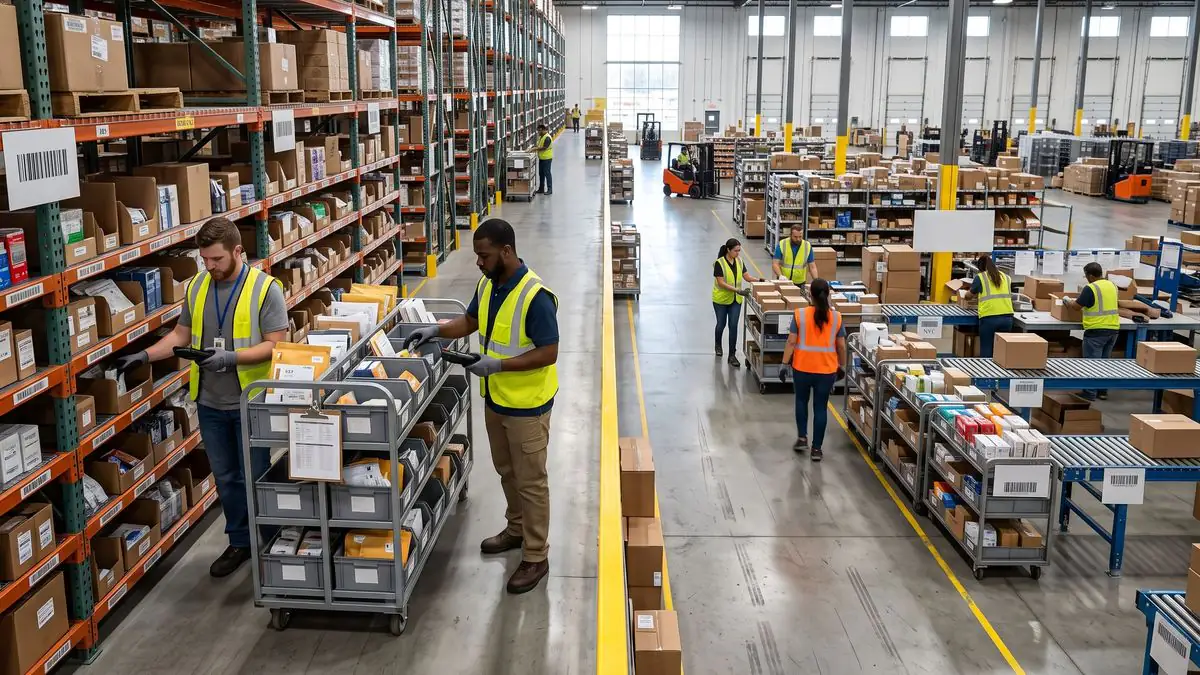
The morning orders are already in, pickers are on the floor, and the first carts are moving through the warehouse. From a distance, everything looks efficient.
Then the flow starts to break. Some orders move quickly, while others wait longer than expected. The issue is not necessarily how fast people are picking. It may be how the work itself is being organized.
That is where the choice between wave picking vs. batch picking comes in.
Batch picking groups compatible orders into one picking run to reduce repeated travel. Wave picking organizes when groups of work enter fulfillment based on timing or priority. Neither is universally better, and warehouses can use both. The right approach depends on where your current process is losing time or control.
Key takeaways
- Batch picking focuses on grouping orders efficiently. It can reduce repeated travel when several orders send pickers to the same parts of the warehouse.
- Wave picking focuses on coordinating work. Orders can be released according to timing and operational priorities.
- Warehouse size or daily order volume alone cannot tell you which method will work better. Picking performance also depends on how orders move through the warehouse.
- You do not always have to choose between them. A warehouse can release work in waves and batch compatible orders within those waves.
- Before changing picking methods, find out where orders actually slow down. Faster picking provides limited value if the delay starts elsewhere in the fulfillment process.
What is batch picking and how does it work?
Batch picking is a warehouse picking method that groups multiple customer orders into batches so their items can be collected during the same picking route. Its main benefit is reducing repeated travel through the warehouse.
With batch picking, the picker collects items for several orders in a single trip rather than completing each order on a separate route.
Imagine five ecommerce orders each contain products stored in the same part of the warehouse. Processing them separately could send a picker through that area five times. A batch allows those trips to be combined, provided the items can still be separated and assigned to the correct customer orders afterward.
Batching can reduce picker travel, but the result depends on how efficiently the orders can be grouped and picked.
When should you consider batch picking?
Consider batch picking when several orders can share an efficient route through the warehouse. That may be because they contain the same SKUs or send pickers to nearby locations.
It can be a strong fit when:
- Many orders contain relatively few items
- Orders regularly draw inventory from the same warehouse areas
- Carts or totes can keep multiple orders organized during the pick
- Sorting and packing can absorb the batches without creating another bottleneck
Reducing picker travel does not guarantee faster fulfillment.
As batches grow, the warehouse may save travel but create more sorting work. Cart capacity can also limit how many orders a picker can handle efficiently at once. Bigger batches are not automatically better.
What is wave picking and how does it work?
Wave picking organizes fulfillment work into groups that are released at planned times or according to defined priorities. This gives the warehouse more control over when work enters picking instead of releasing every order immediately.
A retailer might, for example, organize fulfillment work around shipping priorities or carrier deadlines. Instead of treating every open order identically, the operation can decide which work should be released and when.
That makes wave-based fulfillment useful when coordination, rather than repeated travel alone, is the problem.
When should you consider wave picking?
Consider wave picking when some orders need to move through fulfillment before others, or when work needs to reach packing by a specific deadline.
An ecommerce retailer might need expedited orders picked before standard deliveries. A warehouse working toward an afternoon carrier cutoff may need the right orders at packing before that deadline.
Wave planning can help create that structure.
There is a trade-off, however. Work waiting for a scheduled release can increase order waiting time, while releasing too much work at once can put pressure on downstream operations.
Wave picking should not be treated as an automatically more advanced version of batch picking. It addresses a different operational need.
Wave picking versus batch picking at a glance
The main difference is what each method controls. Batch picking decides which orders are collected together. Wave picking helps control when groups of work enter fulfillment.
|
Batch picking |
Wave picking |
|
| Primary focus | Grouping compatible orders for collection | Organizing and releasing groups of fulfillment work |
| Main opportunity | Reduce repeated picking travel | Coordinate work around operational priorities |
| Especially useful when | Orders have useful SKU or location affinity | Timing, priority, or capacity needs to be controlled |
| Important constraint | Cart capacity and downstream sorting | Waiting time and workload peaks |
| Requires fixed schedules? | No | Not necessarily; release rules can vary by system and operation |
| Can it be combined with the other method? | Yes | Yes |
Warehouse teams do not always use these terms in exactly the same way. Some use “wave picking” to describe the wider picking process, not just the release of work. For this comparison, the useful distinction is between grouping compatible orders and controlling when work enters fulfillment.
Can wave and batch picking be used together?
Yes. A warehouse can release orders in a wave and then batch compatible orders within that wave. The first decision controls when the work enters fulfillment; the second controls which orders are picked together.
Suppose an ecommerce warehouse has an afternoon carrier pickup.
The warehouse can first group the orders that need to be made for that pickup. Within that wave, orders that draw from the same part of the warehouse can be batched for picking.
The wave helps protect the shipping deadline, while batching can reduce repeated travel.
A hybrid process is not automatically better, however. Every additional rule creates another process that employees and systems must manage. Combining methods is worthwhile when the added coordination solves a measurable problem rather than simply making the workflow more complex.
Manage wave and batch picking with Brightpearl
A picking plan is only as useful as the order and inventory information behind it. If that information is outdated or disconnected, teams can still run into exceptions during the pick.
Brightpearl’s Retail Operating System supports both batch and wave picking within its warehouse management capabilities. Because those workflows connect to order and inventory data on the same platform, teams can manage picking as part of the broader fulfillment process.
Want to see how Brightpearl supports batch and wave picking alongside your other retail workflows? Book a demo.
Wave picking and batch picking FAQs
Does a business need warehouse software to use batch picking?
Not necessarily. The basic idea of grouping compatible orders can be applied without sophisticated software. Manual coordination becomes harder as fulfillment grows and more people need to work from the same picking plan. Software can help organize larger batches and manage that work as the operation becomes more complex.
How should you test a new picking strategy?
Test the change on a limited part of the operation rather than changing the entire fulfillment process at once. You could start with one order type or one warehouse area. Choose the metric you want to improve and compare the new process with the old one. Before expanding the change, check whether it has created delays further downstream.
A successful test should improve the business outcome you selected without simply shifting delays or costs to another part of the fulfillment process.
When should you reassess your warehouse picking strategy?
There is no universal schedule. Reassess the process when the warehouse or the orders it handles change enough that the original picking logic no longer fits. A move to a new facility, for example, can change the routes that once made a batch efficient.
A process that worked when orders were concentrated among a small number of products may become less effective as the assortment and fulfillment requirements become more complex.
How does zone picking differ from wave and batch picking?
Zone picking divides the warehouse into zones and assigns picking work within them. It solves a different problem from batching or wave release, so a warehouse can combine zone picking with either approach.


