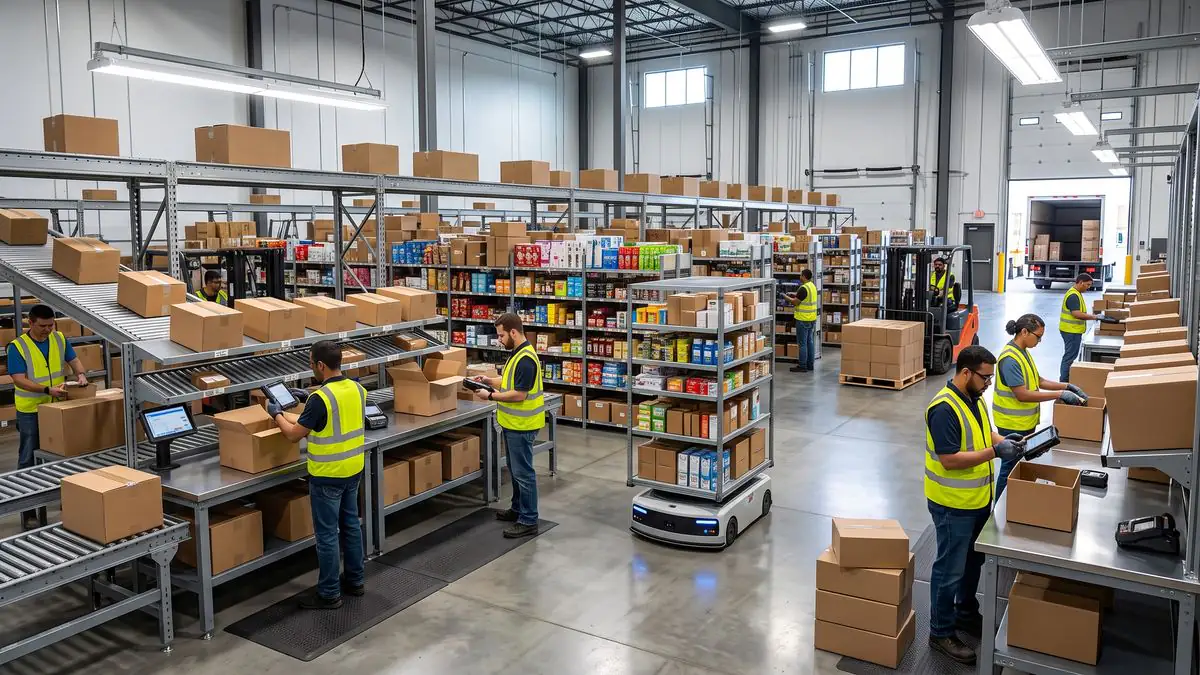
A longer feature list does not make a warehouse management system the right choice. The right system fits your order volume, warehouse processes, sales channels, and wider retail operations without adding unnecessary cost or complexity.
Some ecommerce businesses require advanced warehouse execution, labor management, and robotics support. Others need a broader platform that unifies core operational functions:
- Multichannel orders and inventory
- Purchasing and multi-location fulfillment
- Integrated retail financials
The ten systems below serve different types of ecommerce operations, from smaller DTC warehouses to complex distribution networks.
Key Takeaways
- Determine whether operational complexity is concentrated inside the warehouse or spread across the wider retail business.
- Compare dedicated WMS platforms, ERP modules, and Retail Operating Systems as distinct product categories.
- Use exception-heavy demonstrations to uncover workflow and integration gaps before implementation.
- Model how costs will change as locations, users, order volume, and system requirements grow.
- Avoid paying for enterprise warehouse depth unless current or near-term operations can actively use it.
What Is a Warehouse Management System?
A warehouse management system (WMS) is software designed to coordinate physical inventory and warehouse activities—from receiving and putaway through picking, packing, and shipping.
More advanced warehouse management systems also support extended facility operations:
- Inventory replenishment and cycle counting
- Labor planning and performance tracking
- Warehouse robotics and automation equipment
- Multi-location fulfillment and return processing
A dedicated WMS focuses primarily on floor-level execution. Inventory and order management platforms cover some of the same processes but typically provide less facility-level control. Meanwhile, ERP warehouse modules and Retail Operating Systems connect warehouse activity with broader back-office business functions.
These categories matter because each product type offers a different level of operational depth.
The Best Warehouse Management Systems at a Glance
The systems below are not ranked from one to ten. Each has been assigned a best-fit category based on its documented capabilities and intended users.
| Warehouse management system | Best for | System type | Main strength | Main tradeoff |
| Brightpearl | Connecting fulfillment with wider retail operations | Retail Operating System | Unified orders, inventory, purchasing, warehouse workflows, and retail financials | Less specialized than an enterprise WMS for highly automated facilities |
| Manhattan Active WM | Complex enterprise omnichannel fulfillment | Enterprise WMS | Deep warehouse execution and automation support | Likely more system complexity than smaller retailers require |
| Blue Yonder WMS | Large, automated warehouse networks | Enterprise WMS | Coordinates inventory, labor, and automated operations across complex facilities | Best suited to businesses with substantial operational scale |
| SAP EWM | Businesses already using SAP | ERP-connected enterprise WMS | High-volume warehouse execution integrated with SAP supply chain processes | Requires SAP expertise and a wider SAP strategy |
| Oracle Fusion Cloud WMS | Oracle users managing B2B and B2C fulfillment | Cloud enterprise WMS | Omnichannel fulfillment within Oracle Cloud SCM | Strongest fit for organizations invested in Oracle |
| NetSuite WMS | Growing companies using NetSuite ERP | ERP warehouse module | Warehouse operations connected with ERP inventory and financial data | May not match the depth of specialist enterprise systems |
| ShipHero | DTC brands and ecommerce 3PLs | Ecommerce WMS | Ecommerce-focused inventory, picking, packing, and shipping workflows | Wider planning and financial workflows may require other systems |
| Logiwa IO | High-volume B2C and DTC fulfillment | Cloud fulfillment WMS | Smart job batching, automation rules, and multi-warehouse control | May be excessive for businesses with simpler fulfillment needs |
| Extensiv 3PL Warehouse Manager | Multi-client third-party logistics operations | 3PL WMS | Client billing, inventory separation, and ecommerce integrations | Designed around 3PL requirements rather than owned retail operations |
| Deposco | Distributed DTC and B2B fulfillment | Cloud WMS and fulfillment suite | Warehouse execution across complex retail and consumer goods networks | Its broader scope may exceed the needs of smaller merchants |
Evaluating Warehouse Management Systems
We reviewed current product information from each provider and assessed the platforms against requirements that matter to ecommerce and retail businesses:
- Receiving, putaway, and inventory control
- Picking, packing, and shipping
- Ecommerce and marketplace coordination
- Multi-location fulfillment
- Barcode and mobile workflows
- Returns and order exceptions
- Warehouse automation
- Integration with orders, purchasing, and financial systems
- Suitability for different business sizes and operating models
The comparison is based on current vendor documentation rather than independent head-to-head testing. No single platform is the best choice for every ecommerce operation.
Brightpearl
Brightpearl is a Retail Operating System built specifically for growing retail, wholesale, and ecommerce businesses.
Unlike standalone tools, Brightpearl unifies floor execution with essential back-office channels:
- Warehouse Workflows: Barcode-supported pick, pack, and ship operations, multi-location inventory management, stock transfers, and returns.
- Connected Retail: Direct integration between warehouse activity, multichannel orders, purchasing, and built-in retail accounting.
- Fulfillment Automation: An automated Automation Engine that handles complex order splitting, partial fulfillment, dropshipping, and back-to-back ordering.
Brightpearl is a strong fit when warehouse problems stem from broader retail challenges, such as disconnected channel data, manual order routing, or limited financial visibility. Retailers operating robotics-heavy or highly specialized distribution centers should also evaluate dedicated enterprise WMS platforms.
Manhattan Active Warehouse Management
Manhattan Active WM is designed for large organizations with complex distribution requirements. It combines traditional warehouse management with execution capabilities that coordinate both employees and automated equipment.
The platform directly integrates with advanced facility technology:
- High-speed sortation systems and put walls
- Automated storage and retrieval systems (ASRS)
- Warehouse robotics and autonomous mobile robots (AMRs)
Manhattan also offers related order management, transportation, and store fulfillment products for businesses building a wider omnichannel technology environment. Smaller ecommerce businesses may find the implementation scope and functionality greater than their operations require.
Blue Yonder WMS
Blue Yonder WMS is built for complex facilities that need to coordinate inventory, warehouse tasks, labor, and automation across a larger network.
Its functional architecture spans several key areas:
- Inbound & Inventory: Streamlined receiving, cross-docking, and inventory management.
- Outbound & Execution: Task optimization, resource management, and outbound shipping across global networks.
Blue Yonder is engineered for large, automated facilities. Mid-sized retailers with simpler picking and shipping workflows may not need that level of control.
SAP Extended Warehouse Management
SAP Extended Warehouse Management (EWM) supports high-volume warehouse operations, seamlessly connecting floor execution with broader SAP supply chain and enterprise processes.
Key capabilities include:
- Inbound and outbound handling
- Complex storage and stock movements
- Directed warehouse task management
- Operational analytics and automation integration
SAP EWM makes the most sense for companies already committed to SAP S/4HANA. For existing SAP customers, this native alignment significantly reduces the complexity of connecting a separate warehouse platform.
Oracle Fusion Cloud Warehouse Management
Oracle Fusion Cloud Warehouse Management supports retail, ecommerce, B2B, and direct-to-consumer fulfillment. As part of Oracle Fusion Cloud Logistics within Oracle Cloud SCM, it links warehouse activity directly to supply chain functions.
Key platform features include:
- Omnichannel order fulfillment
- Labor optimization and resource management
- Connections with robotics and material-handling equipment
Existing Oracle users gain the clearest advantage because the WMS sits within the broader Oracle ecosystem. Companies outside that environment should carefully evaluate the integration and implementation demands compared to independent WMS options.
NetSuite WMS
NetSuite WMS extends the NetSuite ERP environment by introducing mobile barcode workflows directly onto the warehouse floor.
Core functional capabilities include:
- Mobile receiving and directed putaway
- Barcode-guided picking, packing, and shipping
- Cycle counting and return authorization receipts
Because warehouse transactions remain connected with NetSuite inventory, orders, and financial data, the platform eliminates the need to synchronize a separate WMS with the ERP. Retailers with highly specialized labor or robotics requirements should confirm whether the module provides sufficient depth before committing.
ShipHero
ShipHero is a cloud warehouse management system built for direct-to-consumer brands and third-party logistics providers operating their own facilities.
The platform consolidates core ecommerce fulfillment tasks:
- Mobile inventory control and receiving
- Batch picking, packing, and parcel shipping
- Pre-built storefront and marketplace integrations
- Dedicated multi-client management tools for 3PLs
ShipHero excels for DTC brands processing high volumes of parcel orders. However, retailers seeking purchasing, demand planning, and retail accounting in the same platform will need to pair it with additional financial systems.
Logiwa IO
Logiwa IO is engineered for high-volume fulfillment environments serving B2C, DTC, and 3PL operations.
Its high-throughput fulfillment features include:
- Multi-warehouse control and dynamic picking locations
- Smart job batching and automated fulfillment rules
- Mobile floor applications and real-time exception handling
Logiwa is ideal for high-volume order fulfillment. Businesses with low order volume or basic warehouse processes may not receive enough value from its specialized fulfillment depth.
Extensiv 3PL Warehouse Manager
Extensiv 3PL Warehouse Manager is built specifically around the operational needs of third-party logistics providers rather than individual retail brands.
Key features engineered for 3PLs include:
- Multi-client inventory separation and automated billing rules
- Floor execution covering receiving, putaway, picking, packing, and parcel shipping
- Turnkey connections for marketplaces, storefronts, carriers, and accounting software
Extensiv simplifies managing multiple client inventories and automated handling charges. A retailer managing only its own stock will find much of that multi-client functionality unnecessary.
Deposco
Deposco’s warehouse management software provides essential floor capabilities alongside a broader supply chain management suite.
Core product features cover:
- Floor Operations: Receiving, scanning, picking, packing, shipping, and carrier rate shopping.
- Supply Chain Suite: Distributed order management, demand planning, and multi-location fulfillment.
Deposco fits growing retailers managing several locations, sales channels, and fulfillment models. Smaller merchants should confirm that the platform’s broader scope aligns with their immediate requirements and available implementation resources.
How to Choose the Right Ecommerce Warehouse Management System
Start by mapping your complete order lifecycle rather than compiling a generic feature list. Document how inventory enters your facility, where it is stored, how orders are allocated, and what happens when normal workflows encounter exceptions.
Before booking vendor demonstrations, evaluate these five key areas:
Define your warehouse complexity
Document key operational metrics across your business:
- Facility Layout: Number of warehouses, stores, zones, and detailed bin structures.
- Volume & Catalog: Active SKUs, daily order volume, and connected sales channels.
- Special Handling: Requirements for lot tracking, expiration dates, serial numbers, wholesale orders, or robotics.
Separate warehouse needs from wider retail needs
Identify where your operational bottlenecks truly lie:
- Inside the facility: Choose a dedicated WMS if challenges center on physical floor execution, slotting, or labor tracking.
- Across the business: Choose a Retail Operating System if issues stem from purchasing, multichannel order routing, inventory synchronization, or financial reporting.
Test complete workflows
Ask vendors to demonstrate your exact operational scenarios, specifically exception-heavy workflows:
- Partial receipts and stock transfers
- Bundling, kitting, and backorders
- Split shipments, order cancellations, and customer returns
Assess floor-level usability
Include warehouse employees in product demonstrations. Count the exact screens, scans, and manual decisions required to complete routine tasks and resolve everyday floor errors.
Calculate the full cost
Look beyond base software subscription fees to model the total cost of ownership:
- Upfront Costs: Implementation, data migration, custom integrations, and hardware investments.
- Scaling Triggers: Price increases associated with adding users, order volume, warehouses, or extra modules.
Do You Need a Dedicated WMS?
A dedicated warehouse management system provides the greatest value when facility complexity outgrows basic inventory tools.
Clear indicators that deeper WMS functionality is necessary include:
- Multiple warehouses, zones, or granular bin locations
- High daily order or SKU volumes
- Frequent picking, packing, or shipping errors
- Complex replenishment or slotting strategies
- Mandatory lot, serial, or expiration tracking
- Advanced labor planning and warehouse robotics
Keep in mind that new software is not always the first answer. Inaccurate product records, inconsistent scanning habits, poor labeling, or an inefficient floor layout should be corrected first. A WMS can enforce efficient workflows, but it cannot fix broken operational rules.
Connecting Warehouse Operations With the Rest of Your Retail Business
An order change ripples across your entire operation—influencing stock allocation, picking, shipping, customer communication, purchasing, and financial reporting.
Brightpearl unifies these workflows inside a dedicated Retail Operating System built specifically for retail and ecommerce businesses. By keeping warehouse tasks directly connected to your core back-office data, you eliminate the friction of moving information between separate systems.
Book a customized Brightpearl demo to see how connected retail operations can power your next phase of growth.
Warehouse Management System FAQs for Ecommerce Retailers
Do retailers need their own WMS when using a 3PL?
Not always. The 3PL will typically use its own WMS to manage stock and fulfillment inside its facilities. However, the retailer still requires central inventory and order management tools, along with a reliable integration to route orders and receive real-time stock, shipment, and tracking updates.
Can the same warehouse management system handle DTC and wholesale orders?
Yes, but the underlying workflows differ significantly. DTC fulfillment focuses on high volumes of small parcel orders, whereas wholesale requires:
- Case or pallet picking
- Customer-specific labeling and compliance documents
- Scheduled carrier freight deliveries
Both workflows should be thoroughly tested during software selection.
What data should be prepared before WMS implementation?
Standardize foundational operational data prior to project kickoff:
- Master Records: Accurate SKU listings, barcodes, units of measure, bin locations, initial inventory counts, and user roles.
- Standard Operating Procedures: Defined picking strategies, replenishment rules, packaging requirements, carrier services, and exception protocols.
How long does a WMS implementation take?
Implementation timelines vary widely based on warehouse count, custom integrations, data quality, workflow complexity, and employee training. Rollouts conducted in phases can minimize operational risk for businesses running multiple locations or continuous fulfillment operations.
How often should ecommerce businesses review their WMS?
Establish a regular review cycle and re-evaluate your system whenever major operational changes occur:
- Opening new warehouses or fulfillment centers
- Adding sales channels or expanding into new product categories
- Introducing warehouse automation or robotics equipment
- Experiencing rising order error rates, processing delays, or integration bottlenecks