Warehousing logistics helps retailers coordinate how inventory enters, moves through, and leaves a warehouse. It connects physical activities such as receiving, storage, picking, and shipping with the systems that manage orders, stock availability, purchasing, and financial records.
This coordination becomes more important as a retail business grows. Additional sales channels, products, warehouses, and fulfillment partners create more decisions and more opportunities for inventory errors or delays. Effective warehousing logistics can help retailers manage that complexity without increasing manual work at the same rate as order volume.
Key Takeaways
- Warehouse performance depends on the flow of inventory and information across the wider retail operation.
- Growth creates more exceptions, locations, and channel demands, not simply more orders.
- Reliable product, inventory, and location data should support every warehouse workflow.
- Automation delivers the most value when it addresses a defined and repeatable operational constraint.
- Retailers should assess improvements through order speed, accuracy, cost, and control rather than isolated task metrics.
What Is Warehousing Logistics?
Warehousing logistics is the planning and coordination of inventory movement, storage, and information within a warehouse or fulfillment network.
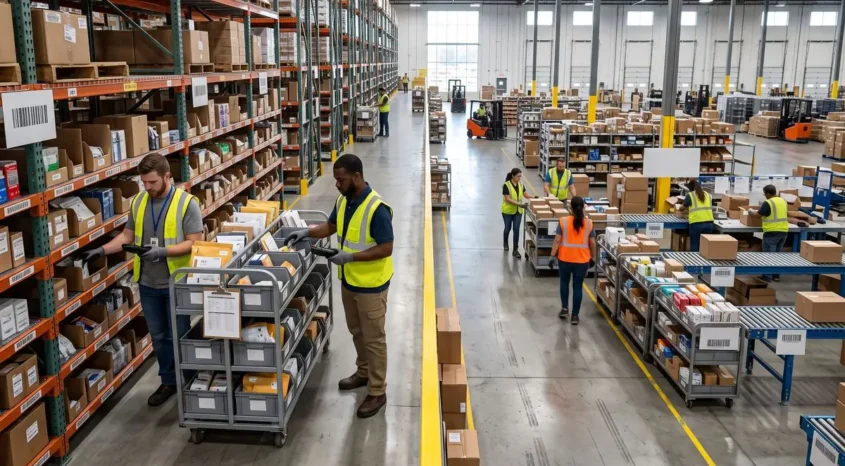
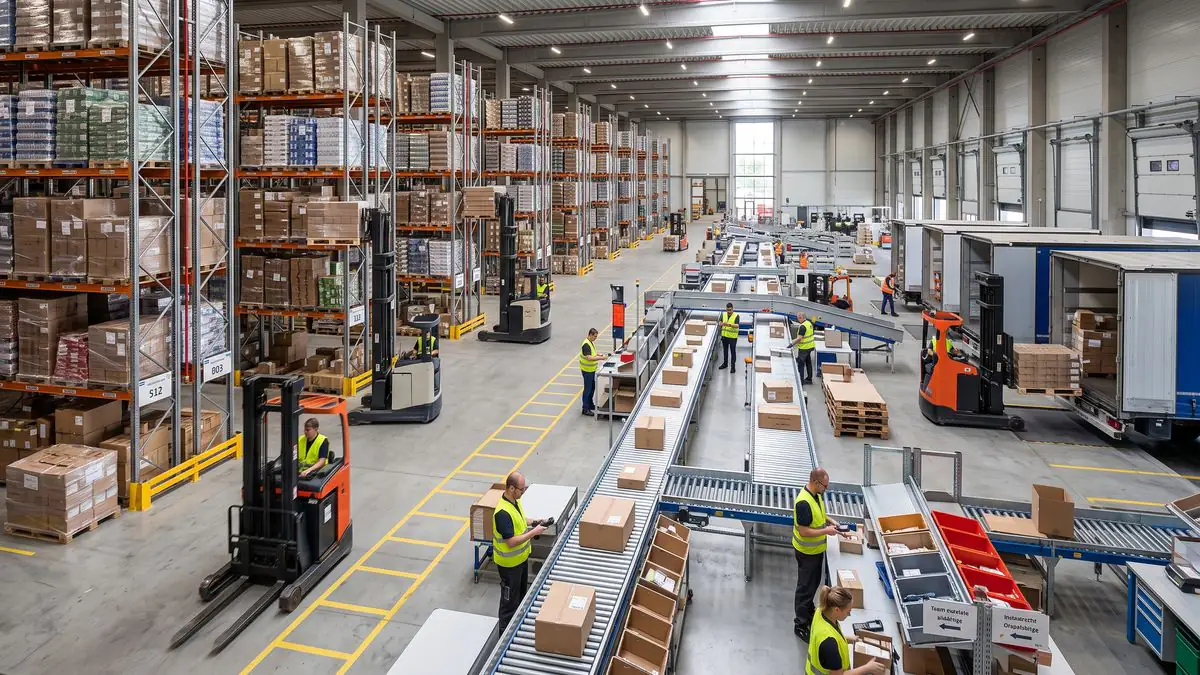
It covers the physical flow of products through activities such as:
- Receiving incoming goods
- Inspecting and recording inventory
- Assigning products to storage locations
- Replenishing picking areas
- Picking and packing orders
- Transferring stock between locations
- Processing returns
- Preparing shipments for collection
It also includes the information that directs those activities. Warehouse teams need accurate data about product locations, available quantities, order priorities, purchase orders, inventory transfers, and shipping requirements.
For retailers, warehousing logistics should not operate separately from the rest of the business. A warehouse decision can affect sales-channel availability, customer delivery times, purchasing requirements, and financial reporting.
Warehousing Logistics vs. Related Retail Functions
Several retail operations terms overlap, but they do not describe the same responsibilities.
|
Function |
Primary focus |
| Warehousing | Providing space and facilities for storing goods |
| Warehousing logistics | Coordinating the movement, storage, and supporting information within warehouses |
| Warehouse management | Managing the people, processes, and systems used to operate a warehouse |
| Inventory management | Controlling stock quantities, availability, value, and replenishment across the business |
| Fulfillment logistics | Processing customer orders from order capture through delivery and returns |
| Supply chain management | Coordinating the wider network of suppliers, production, inventory, distribution, and customers |
Improving one function does not necessarily fix the wider operation. Faster picking will not prevent overselling when sales channels rely on inaccurate stock data. More warehouse space will not fix delayed receiving or poor order allocation.
Warehousing logistics keeps these functions aligned, reducing delays and conflicting inventory records.
Why Warehousing Logistics Becomes Harder as Retailers Scale
As retailers grow, warehouse work becomes more complex, not just busier. Teams must handle more channels, stock locations, and exceptions alongside higher order volumes.
More sales channels compete for shared inventory
Ecommerce stores, marketplaces, wholesale accounts, and physical locations may all sell from the same inventory pool.
Without coordinated stock data, one channel may accept an order for inventory that has already been allocated elsewhere. Warehouse teams then have to investigate shortages, divide orders, or wait for replenishment.
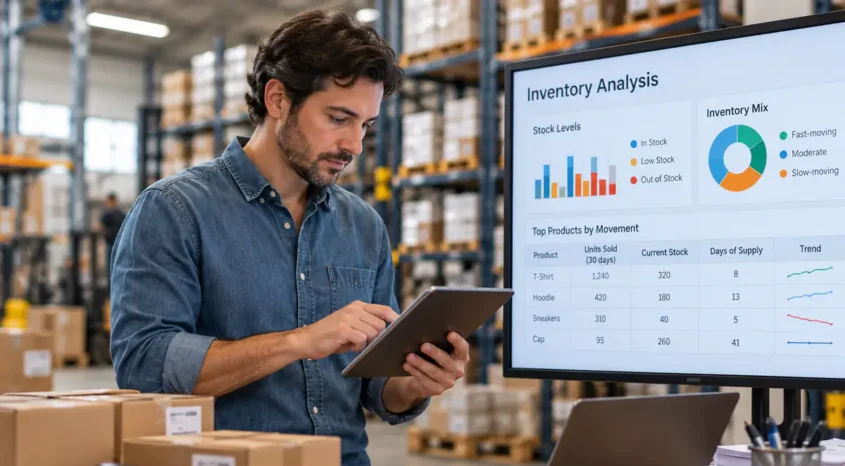
Warehouse inventory tracking helps teams understand what stock is physically present, available for sale, reserved for existing orders, or expected from suppliers.
Product ranges become more complex
Adding SKUs increases the number of receiving, storage, and picking decisions the warehouse must support.
Products can also have different requirements. Fast-selling items need accessible picking locations, while bulky, fragile, seasonal, or slow-moving goods may need separate handling and storage rules.
A layout that worked for a smaller catalog may create unnecessary travel and congestion as the assortment expands.
Exception handling becomes more demanding
Higher-order volume leads to more address changes, damaged goods, partial shipments, payment holds, priority orders, and stock discrepancies.
Routine steps can often be standardized or automated. Exceptions still require accurate information and clear ownership. When employees must check multiple systems to understand a single order, the manual workload can increase quickly.
Multiple locations divide inventory visibility
A second warehouse or 3PL can add capacity and place stock closer to customers. It also creates another inventory position to monitor.
The retailer must decide:
- Where products should be stored
- Which location should fulfill each order
- When stock should be transferred
- Whether orders should be split
- How each location reports receipts, shipments, and returns
These decisions become difficult when warehouse and order data are updated at different times or use different stock definitions.
Peak demand exposes weak processes
Promotions and seasonal demand place pressure on receiving, picking, packing, labor, and carrier capacity at the same time.
Manual workarounds that seem manageable during normal periods often fail during peak periods. Retailers need repeatable workflows and realistic capacity plans before demand rises.
How to Identify the Real Warehousing Constraint
Before adding technology, labor, or space, diagnose the cause of the warehouse problem.
|
Operational symptom |
Possible causes |
First area to investigate |
| Employees cannot find stock shown as available | Unrecorded movements, inaccurate locations, or incomplete receiving | Inventory and location accuracy |
| Orders wait before entering the picking process | Manual allocation, payment holds, or delayed order release | Order-management workflows |
| Picking is fast, but shipments still leave late | Packing congestion, documentation, or carrier capacity | End-to-end order flow |
| One warehouse stocks out while another holds excess | Weak allocation, forecasting, or transfer rules | Network inventory visibility |
| Sales growth requires a similar increase in headcount | Too many manual decisions or order exceptions | Workflow standardization and automation |
| Warehouse and financial records do not agree | Disconnected receipts, adjustments, returns, or landed costs | Operational and financial integration |
| A 3PL reports different stock quantities | Integration delays or inconsistent inventory statuses | Data definitions and reconciliation |
A symptom may have more than one cause. For example, a late shipment could result from slow picking, but it could also begin with delayed order allocation or inaccurate inventory.
The priority is to remove delays across the full order process, not make one task faster while work builds up elsewhere.
How to Improve Warehousing Logistics
1. Standardize receiving and inventory records
Inventory accuracy begins when goods arrive.
Warehouse teams need a consistent warehouse receiving process for:
- Matching deliveries to purchase orders
- Recording received quantities
- Identifying damaged or missing goods
- Applying product labels
- Assigning storage locations
- Updating inventory availability
- Escalating supplier discrepancies
The business should also define when inventory becomes available for sale. Stock that has arrived but has not been checked or put away should not appear identical to inventory that is ready to fulfill an order.
Clear inventory statuses help warehouse, purchasing, sales, and finance teams work from the same operational information.
2. Organize storage around product movement
Storage decisions should reflect how products move through the operation.
Fast-selling products should generally be placed close to picking and packing areas. Slow-moving stock can use less accessible locations. Heavy, oversized or fragile products require storage that supports safe handling.
Retailers should review these assignments as demand changes. A seasonal product may require a prominent picking location for several weeks and then move back to reserve storage.
Better slotting can reduce travel and improve the use of existing warehouse space. It should be based on product velocity, order combinations, and handling requirements rather than employee memory alone.
3. Coordinate orders and inventory across channels
Warehouse teams need a clear view of which orders should be processed, where they should be fulfilled, and which inventory is available to them.
Order-allocation rules can account for factors such as:
- Stock availability
- Warehouse location
- Sales channel
- Customer destination
- Delivery service
- Order value
- Product type
- Carrier cutoff
- Split-shipment limits
The closest warehouse is not always the best choice. It may lack one item, have limited capacity, or need to preserve inventory for another channel.
Automated allocation can apply established rules consistently. Teams should still define how the system handles exceptions and when an employee should intervene.
4. Automate repeatable work selectively
Automate work only when the team can identify the recurring delay, decision, or error it needs to remove.
Retailers may automate:
- Order routing
- Inventory updates
- Replenishment notifications
- Picking-list creation
- Shipping-method selection
- Warehouse transfers
- Low-stock alerts
- Customer notifications
- Accounting updates
Before evaluating technology, identify the recurring decision or bottleneck limiting the operation.
Automation can improve one activity while moving the bottleneck elsewhere. Faster picking provides limited value when packing stations or carrier collections cannot handle the resulting volume.
Measure the effect across the complete order cycle.
5. Build returns into the warehouse workflow
Returns are part of warehousing logistics, not a separate after-sales task.
Returned products need to be:
- Received
- Inspected
- Assigned a condition
- Restocked, repaired, or written off
- Reflected in inventory records
- Connected to a refund or replacement
Delays in this process keep sellable inventory unavailable and make stock records harder to reconcile.
Retailers should establish clear return reasons and product conditions. This information helps warehouse teams process goods consistently and provides the wider business with better insight into recurring product or fulfillment issues.
6. Plan warehouse capacity using demand information
Capacity includes more than square footage.
Retailers should assess:
- Receiving capacity
- Storage availability
- Picking locations
- Packing stations
- Labor hours
- Equipment
- System throughput
- Carrier collections
- Returns-processing space
Forecasts, purchasing plans, and promotional calendars can help teams identify upcoming pressure before orders reach the warehouse.
Depending on the constraint, the business may need to redesign a process, add a shift, increase capacity, or use a fulfillment partner. Retailers should not assume one solution will address every form of capacity constraint.
In-House Warehousing, 3PLs or a Hybrid Model
Retailers can operate their own warehouses, outsource fulfillment to a 3PL, or combine both approaches.
In-house warehousing
An internal warehouse offers direct control over inventory, packaging, workflows, and customer experience.
It can suit retailers with specialized products, distinctive packaging requirements, or enough consistent volume to support their own facilities and teams.
The trade-off is responsibility for labor, equipment, systems, compliance, and capacity.
Third-party logistics
A 3PL can provide additional capacity, technology, and geographic coverage without requiring the retailer to build another operation.
However, outsourcing does not remove the need for oversight. The retailer still needs visibility into inventory, order status, returns, exceptions, and service performance.
Contract terms, integration quality, data ownership, and exit conditions should be reviewed alongside fulfillment rates and pricing.
Hybrid warehousing
A hybrid model may combine an internal warehouse with one or more external partners.
For example, a retailer may fulfill core domestic orders internally while using a 3PL for another region, seasonal overflow, or a specific sales channel.
This model can provide flexibility, but it requires clear order-allocation rules and consistent data across every location.
Choosing the Right Warehouse Technology
Retailers do not all need the same technology architecture.
Some may use warehouse functionality within a broader retail platform. Others may integrate a specialized WMS with their order, inventory, and accounting systems. A business using a 3PL may rely partly on the provider’s warehouse platform.
Whatever the setup, warehouse data must stay aligned with orders, purchasing, and inventory records.
Warehouse systems should exchange accurate information with:
- Ecommerce platforms
- Marketplaces
- Order-management workflows
- Inventory records
- Purchasing
- Shipping providers
- 3PL partners
- Customer service
- Retail accounting
A unified platform can reduce integration work and duplicate records. A modular system can provide greater specialization and flexibility.
Evaluate both approaches based on operational fit, implementation effort, integration maintenance, data portability, and switching costs. System consolidation makes sense only when it reduces manual work without weakening essential warehouse workflows.
Which Warehouse Metrics Should Retailers Track?
Track metrics that point to a specific operational decision.
Useful measures include:
|
Metric |
What it helps evaluate |
| Dock-to-stock time | How quickly received goods become available |
| Inventory accuracy | Whether system records match physical inventory |
| Location accuracy | Whether products are stored where the system says they are |
| Order cycle time | How long orders take to move from release to shipment |
| Picking accuracy | Whether employees select the correct products and quantities |
| Manual intervention rate | How many orders require employee investigation |
| Cost per fulfilled order | How operational costs change as volume grows |
| Split-shipment rate | How often inventory placement creates multiple shipments |
| Return-to-resale time | How quickly sellable returns become available again |
No metric should be reviewed on its own.
A higher cost per order may result from overtime, inefficient travel, packaging requirements, shipping decisions, or a rise in exceptions. Managers should connect the metric to warehouse activity and wider order data before selecting a response.
How Brightpearl Connects Warehouse and Retail Operations
Warehousing logistics depends on more than warehouse execution. Growing retailers also need to coordinate orders, inventory, purchasing, fulfillment, and financial workflows.
Brightpearl provides a Retail Operating System built for retail and ecommerce businesses. It connects warehouse activity with the wider operational processes that determine what stock is available, which orders should be fulfilled, and how inventory movements affect purchasing and financial records.
Brightpearl helps retailers:
- Maintain visibility across sales channels and inventory locations
- Manage orders from ecommerce, marketplaces, and other channels
- Automate repeatable order and fulfillment workflows
- Coordinate purchasing and inventory availability
- Connect warehouse and shipping processes
- Reduce manual data transfer between operational teams
- Access current order, inventory, and financial information
Warehouse, purchasing, customer service, and finance teams can work from the same order and inventory records.
Automation should handle repeatable work while giving employees the information needed to resolve exceptions.
Build Warehouse Operations That Can Support Growth
Effective warehousing logistics aligns physical warehouse activity with the wider retail operation.
Start with the actual order profile, inventory challenges, and fulfillment requirements. Then improve processes, data, systems, and external partnerships according to the constraints the business needs to solve.
Automation, integrations, and 3PLs help only when they address the retailer’s actual constraints and remain manageable as the business grows.
Brightpearl connects orders, inventory, purchasing, fulfillment, and financial workflows in one Retail Operating System designed for growing retailers.
Book a demo to see how Brightpearl can help you coordinate retail operations as order volume, channels, and fulfillment complexity increase.
Warehousing Logistics FAQs for Growing Retailers
How often should retailers review warehouse processes?
Review warehouse processes before peak seasons, major promotions, channel launches or facility changes. An additional review is useful when order exceptions, labor costs, stock discrepancies, or fulfillment times begin to increase.
What is cross-docking in warehousing logistics?
Cross-docking moves incoming goods directly from receiving to outbound shipping with little or no storage between the two stages. It can reduce storage and handling time when inbound deliveries can be matched reliably with known outbound demand.
How does warehousing logistics affect customer service?
Accurate warehouse and order data helps customer service teams confirm stock availability, shipment progress, backorders, split shipments, and return status without asking warehouse employees to investigate every request. This gives customers faster and more reliable answers when an order changes or encounters a delay.
Can warehousing logistics help reduce working-capital pressure?
Better inventory visibility can help retailers identify excess stock, delayed receipts, and unnecessary transfers. However, warehouse improvements alone do not determine working-capital performance. Purchasing decisions, demand planning, supplier terms, and product costs also affect how much cash is tied up in inventory.
What should happen if warehouse systems become unavailable?
Retailers should maintain documented outage procedures covering order release, picking, shipping, inventory adjustments, and later reconciliation. The plan should identify which tasks can continue safely and how transactions will be entered once systems are restored.