Many modern retail and e-commerce brands struggle with meeting customer expectations for fast, accurate, and flexible delivery. Whether you are selling through multiple sales channels, global marketplaces, or direct-to-consumer (DTC) websites, providing a seamless experience is essential for business growth. Fulfillment logistics is the system that powers this process, covering everything from receiving and storing to picking, packing, and shipping customer orders.
Implementing fulfillment logistics solutions and operational strategies is the primary way to improve efficiency and visibility in a multichannel environment. This guide explores how effective fulfillment logistics works, its core benefits, common challenges, and how technology can help scale your operations.
Key Takeaways
- Fulfillment logistics is a specialized post-purchase system that connects inventory, warehousing, and shipping to execute customer orders accurately.
- Optimizing the fulfillment process directly influences customer loyalty and brand reputation through faster delivery times and reduced errors.
- Choosing the right fulfillment model—whether in-house, third-party logistics (3PL), or hybrid—is essential for maintaining cost savings during business growth.
- Advanced technology and automated order processing are critical for removing operational bottlenecks and ensuring real-time visibility across all sales channels.
- Continuous monitoring of performance metrics like order accuracy and fulfillment time allows retailers to refine their logistics management for long-term success.
What Is Fulfillment Logistics?
Fulfillment logistics is an end-to-end operational system that connects your inventory, warehousing, order management, and shipping to execute customer orders. It is a specialized subset of the supply chain that focuses specifically on post-purchase execution. While broader supply chain management involves sourcing, manufacturing, and procurement, fulfillment logistics begin at the point of order receipt and end when the product reaches the customer.
It is important to distinguish the system from the outcome. Order fulfillment services refer to the completed act of delivering a product, whereas fulfillment logistics is the comprehensive system and set of logistics services that enable that result. Similarly, shipping logistics focuses only on the transport of goods, while fulfillment logistics covers the end-to-end process.
Key components of this system include inventory management, warehouse management, order consolidation across various sales channels, and intelligent order routing to the best fulfillment locations to cut down on shipping costs. By mastering these elements, an e-commerce company can provide the cohesive customer experience that modern shoppers expect.
Why Fulfillment Logistics Is Important for Retail and E-commerce
Effective fulfillment logistics does more than just move boxes; it acts as a primary driver for brand reputation and customer loyalty. When your backend operations run smoothly, you can focus on expanding your market reach rather than constant troubleshooting.
Consider the following ways that optimized fulfillment logistics benefits your business:
- Enhancing Customer Satisfaction: Fast and accurate deliveries often lead to higher satisfaction levels, fewer complaints, and increased repeat purchases.
- Operational Efficiency: Streamlined logistics management reduces manual labor costs and minimizes the fulfillment errors that frequently occur during manual data entry.
- Scalability for Growth: A structured fulfillment process allows you to support growth across e-commerce platforms and physical stores without overwhelming your fulfillment operations.
- Inventory Accuracy: Managing inventory in real time helps prevent stockouts and overstocking, ensuring you never miss a sales opportunity through accurate inventory management.
- Competitive Advantage: In crowded markets, reliable fulfillment becomes a competitive edge, as delivery speed and accuracy heavily influence modern buying decisions.
Key Stages of the Fulfillment Logistics Process
The fulfillment process consists of several interconnected stages. Coordination across your channels and warehouses is necessary to ensure every order is fulfilled accurately.
1. Receiving Inventory
Your fulfillment cycle begins when goods arrive at your warehouse or storage unit. Staff inspect the items for damage and verify quantities before they store products and update your inventory management system.
2. Inventory Storage
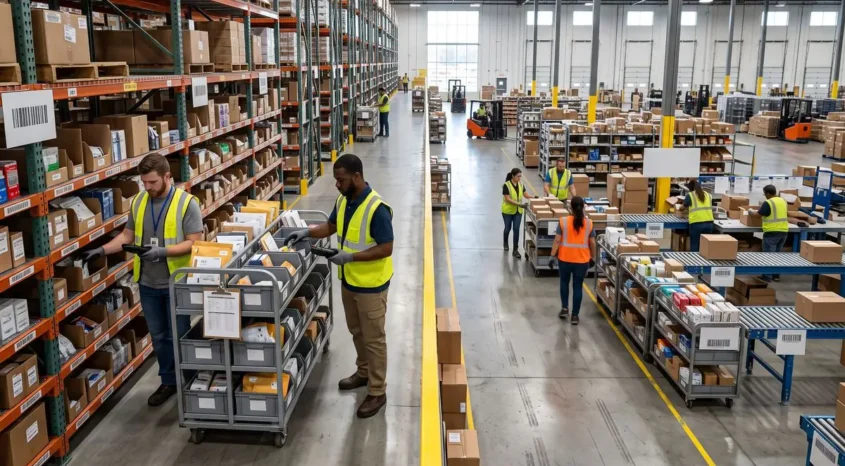
Products are organized into specific areas for efficient retrieval. Using barcode scanning ensures that every item is easy to locate during the picking phase, maintaining high levels of inventory accuracy.
3. Order Management
Orders from all your sales channels are consolidated into a single system. The software then routes these customer orders to the most appropriate warehouse based on inventory availability and the customer’s location to ensure faster delivery.
4. Picking and Packing Process
Warehouse teams use digital pick lists to select items with high order accuracy. They then package the items securely, choosing the right materials to reduce costs and prevent damage.
5. Shipping and Delivery
Once packed, orders are handed off to carriers. Real-time tracking information is typically sent to the customer to manage expectations for the last-mile delivery and timely delivery.
6. Returns Management
Also known as reverse logistics, this stage involves handling exchanges and restocking returned items. A clear process here minimizes disruption and recovers inventory value quickly.
Common Fulfillment Logistics Challenges
Even the most successful retail and e-commerce companies encounter problems as they scale. Identifying and addressing these operational hurdles early allows you to build more resilient logistics management routines that protect your margins and your brand reputation.
Managing Order Complexity
As sales channels multiply, the complexity of managing multiple SKUs and diverse delivery options increases significantly. Without a centralized system, the risk of fulfillment errors and shipping delays rises, which directly impacts customer satisfaction and can lead to negative reviews.
Real-Time Inventory Inaccuracies
A lack of real-time visibility is a common pitfall that leads to stock discrepancies and lost sales opportunities. When inventory levels aren’t updated instantly across all channels, you run the risk of overselling or inefficiently allocating stock, which wastes valuable warehouse space and labor.
Fluctuating Shipping Costs and Delays
Carrier disruptions and rising shipping costs are ongoing challenges that can erode profit margins. Without a way to optimize carrier selection and leverage bulk discounts, businesses often find themselves overpaying for shipping or failing to meet customer expectations for timely delivery.
Inefficient Returns Management
Reverse logistics is often overlooked, but can become a major operational drain. Inefficient returns handling increases labor costs and slows down the recovery of sellable inventory, preventing you from restocking items while demand is still high.
Operating with Disconnected Systems
Perhaps the greatest challenge is the presence of siloed tools. When your e-commerce platform, warehouse software, and accounting systems are disconnected, it creates data inconsistencies that force your team into time-consuming manual work, making it nearly impossible to scale fulfillment operations effectively.
Fulfillment Logistics Models for Retail and E-commerce
Your choice of fulfillment model should align with your business scale and growth strategy. Many companies find that their needs change as they expand into new retail distribution channels.
- In-house Fulfillment: This model gives you full control over your operations and brand reputation. However, it requires significant investment in warehouse space, labor, and technology.
- Third-Party Logistics (3PL): Outsourcing to a third-party logistics provider allows you to scale faster without the overhead of managing your own facility or logistics services.
- Hybrid Fulfillment: Many retailers combine in-house and outsourced fulfillment services. For example, you might handle your core products in-house while using a 3PL for international orders or value-added services.
- Distributed Fulfillment: This involves using multiple fulfillment centers to store products closer to your customers, which typically leads to faster delivery times and measurable cost savings.
Best Practices for Optimizing Fulfillment Logistics
Optimization is a continuous process of refinement. To maintain high service levels as you grow, consider implementing the following best practices to streamline your workflows and reduce operational friction.
Standardize Your Fulfillment Workflows
Creating consistent, repeatable processes for order handling, picking, and packing is essential for reducing errors. When every team member follows a standardized routine, it becomes much easier to identify where bottlenecks occur and train new staff as your order volume increases.
Optimize Warehouse Layout for Efficiency
Design your storage and picking paths to minimize the distance workers need to travel. By placing high-velocity items closer to packing stations and organizing your space strategically, you can significantly reduce handling time and improve overall warehouse throughput.
Align Inventory Across Every Channel
Accurate stock allocation is critical for multichannel success. Ensure that your inventory levels are synchronized across your e-commerce store, marketplaces, and physical retail locations. This prevents stockouts on one channel while items sit idle elsewhere, maximizing your sales potential.
Streamline Your Returns Processes
Reverse logistics should be as efficient as your outbound fulfillment. By creating a structured routine for handling returns, you can recover sellable inventory more quickly and provide a better experience for customers who need to make an exchange, fostering long-term loyalty.
Track and Review Performance Metrics
Regularly monitoring Key Performance Indicators (KPIs) like order accuracy, fulfillment time, and on-time delivery allows you to make data-driven decisions. Use this information to identify inefficiencies in your current logistics management and continuously refine your operations over time.
How Technology Improves Fulfillment Logistics
Advanced technology transforms fulfillment from a manual chore into a strategic advantage. Instead of reacting to problems, you can use automated order processing and orchestration to stay ahead of customer orders.
Automation software can handle repetitive tasks like order routing, inventory updates, and exception handling. This reduces the burden of manual work on your team and limits the risk of human error. When your systems are integrated, you gain real-time visibility across your entire supply chain. This transparency allows you to make better decisions about where to store products and how to allocate stock during peak seasons.
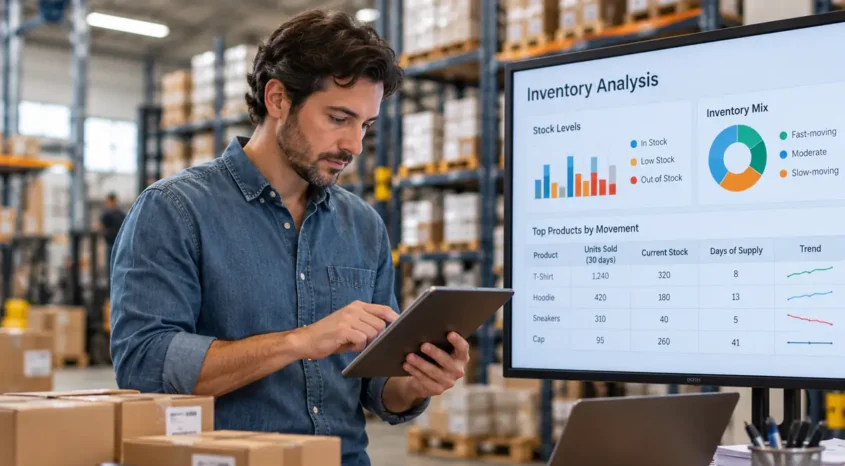
You can also rely on retail reporting and data analytics systems to help you move toward data-driven decision-making. By analyzing historical trends, you can improve your forecasting and ensure you have the right inventory in the right locations before the orders even arrive, helping you prevent stockouts.
Scaling Fulfillment Logistics with Brightpearl
Brightpearl is a retail operating system designed to centralize and optimize fulfillment logistics for growing businesses. It acts as a single source of truth, linking your sales, fulfillment, and retail accounting in one place.
Key capabilities include:
- Centralized Management: Eliminate siloed data by managing orders and inventory from every channel in one interface to ensure a cohesive customer experience.
- Automation Engine: Use the Automation Engine to facilitate automated order processing, significantly reducing manual intervention.
- Real-time Visibility: Gain immediate insights into stock levels and warehouse performance to improve accuracy and decision-making.
- Seamless Integrations: Keep your e-commerce platforms, marketplaces, and shipping providers perfectly aligned.
- Multi-warehouse Support: Efficiently manage high-volume fulfillment operations across multiple locations without increasing complexity.
By using Brightpearl, your business can reduce costs, improve delivery performance, and scale your fulfillment solutions with confidence.
Building a Future-Ready Fulfillment Strategy
Fulfillment logistics is evolving rapidly alongside rising customer expectations and omnichannel complexity. The pressure for fast and accurate deliveries is no longer a luxury but a fundamental requirement for staying competitive in modern retail.
To remain competitive, you need an integrated system that provides the infrastructure for automation and real-time visibility. Moving toward a technology-driven strategy ensures that your fulfillment operations can adapt to new sales channels and changing market conditions. Solutions like Brightpearl provide the clarity and control needed to coordinate fulfillment across your entire business.
If you are ready to streamline your operations and focus on enhancing satisfaction for your customers, book a demo with Brightpearl today to see how we can help you scale your fulfillment logistics.
Frequently Asked Questions
What is fulfillment logistics?
Fulfillment logistics is the comprehensive operational system that manages the end-to-end process of order fulfillment. This includes receiving inventory, warehousing, picking, packing, and shipping customer orders to ensure a cohesive customer experience.
What is the difference between fulfillment and 3PL?
Fulfillment refers to the actual operations and processes required to get a product into a customer’s hands. A third-party logistics provider (3PL) is a business partner that offers fulfillment services, allowing you to outsource your logistics management instead of handling it in-house.