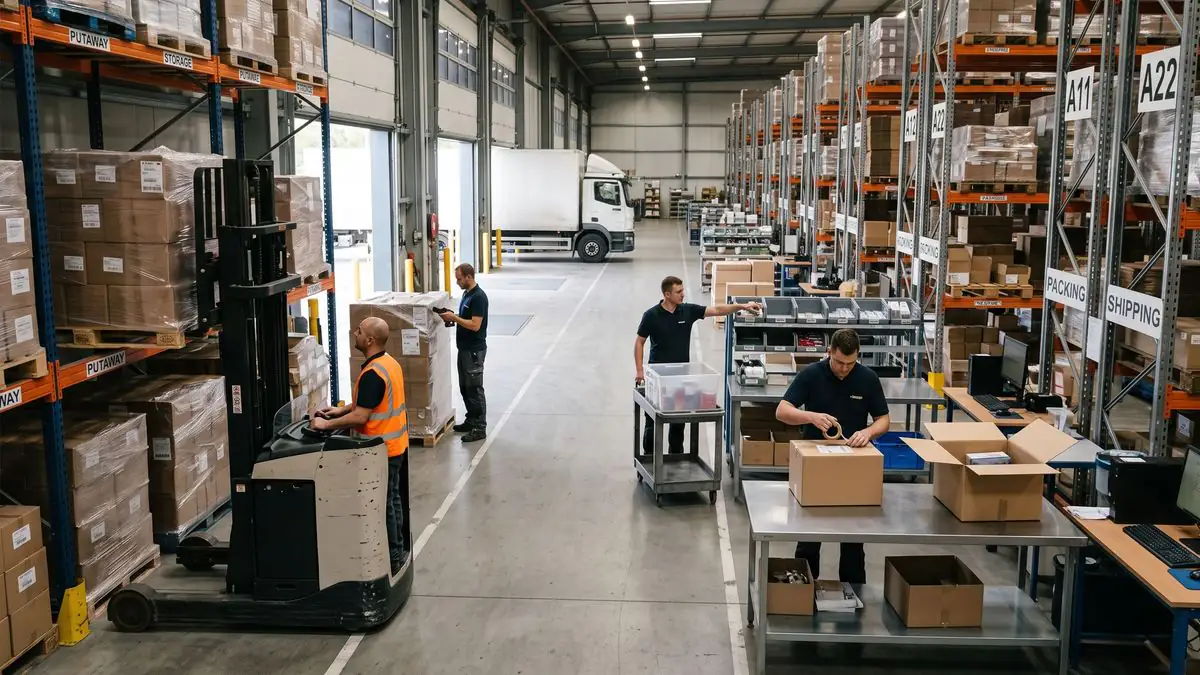
Sometimes, a product can appear to be a poor seller when the real problem is that the stock never reached the store or fulfillment location that needed it. The supplier may have delivered fewer units than expected, inventory may still be waiting in the warehouse, or it may already be assigned to an outbound shipment. Without visibility into each stage, teams can mistake a distribution delay for weak demand and take unnecessary action.
Well-documented warehouse processes and accurate transaction records provide that visibility. They cover the steps for receiving, storing, moving, preparing, shipping, and returning inventory, including receiving, putaway, storage, inventory control, replenishment, picking, packing, shipping, and returns. Tracking stock through each stage helps retailers identify delays, keep inventory and order statuses aligned across channels, and make faster fulfillment decisions.
Key Takeaways
- Confirm deliveries against purchase orders before stock becomes available for fulfillment.
- Maintain traceability as products move between locations and order stages, and keep availability updated across sales channels.
- Match storage and replenishment practices to product velocity, size, and handling needs.
- Evaluate receiving, picking, packing, and shipping as one connected workflow.
- Automate repeatable handoffs when manual updates delay orders or create inconsistent data.
What Are Warehouse Processes?
Warehouse processes are the repeatable activities that control how inventory moves through a facility, from arrival through final shipment or return.
Warehouse research often groups operations into four broad functions:
- Receiving
- Storage
- Order picking
- Shipping
In practice, businesses divide those functions into more specific processes so teams can assign responsibilities, track performance, and identify where errors begin.
The exact workflow depends on the business. A wholesale distributor shipping full pallets operates differently from an ecommerce retailer fulfilling individual customer orders. Product size, order volume, storage requirements, sales channels, and return rates also influence how each process should work.
The processes below provide a practical starting point, but businesses should adapt them to their own models.
Why Effective Warehouse Processes Matter for Inventory Accuracy and Customer Satisfaction
Accurate stock records reduce the risk of cancellations caused by unavailable inventory, while dependable picking, packing, and shipping help prevent delays and incorrect deliveries.
When warehouse movements are recorded consistently and shared across order, inventory, fulfillment, and financial workflows, teams can see what stock is available, where orders stand, and which exceptions require attention. This becomes increasingly important as retailers diversify their sales channels, locations, and fulfillment partners.
Reliable warehouse processes can also reduce avoidable costs caused by:
- Incorrect receipts
- Lost or misplaced products
- Unnecessary stock movements
- Empty picking locations
- Fulfillment errors
- Expedited shipments
- Delayed returns
- Duplicate or premature purchase orders
These failures can tie up cash in unnecessary purchases, increase labor and shipping costs, or leave sellable inventory unavailable. Warehouse efficiency should account for accuracy and safety as well as speed. Faster picking, for example, provides limited value when orders then wait in a packing queue.
1. Receiving and Inspection
Receiving is typically the first warehouse process and confirms that an inbound delivery matches what the business ordered.
The team should compare the shipment with the purchase order and supporting delivery documents. This includes verifying product identifiers, quantities, and units of measure. Goods should also be inspected for visible damage, missing labels, expiration concerns, or other conditions that affect whether they can be sold.
Any discrepancy should be recorded before the inventory becomes available. Damaged or questionable products need a designated holding area until the business decides whether to accept, return, or dispose of them.
A dependable receiving process includes:
- Scheduled delivery windows
- Clear unloading procedures
- Purchase order verification
- Quantity and product checks
- Damage inspection
- Discrepancy documentation
- Barcode or product-label validation
- A quarantine process for unresolved stock
Receiving errors can affect every later warehouse process. When a delivery is recorded incorrectly, teams may search for inventory that never arrived, sell stock that is unavailable or place a purchase order based on a false quantity. In a connected retail operation, receiving records should also update purchase order status, available inventory and, where applicable, related financial records so other teams are not working from outdated information.
2. Putaway
Putaway moves accepted inventory from the receiving area to its assigned storage location.
The goal is not simply to clear the dock. Products must reach a suitable location quickly, and each movement must be recorded. Inventory that remains in staging for too long may physically exist in the warehouse while remaining unavailable for picking or allocation.
Putaway decisions should account for:
- Product dimensions and weight
- Storage conditions
- Sales velocity
- Handling requirements
- Compatibility with nearby products
- Available space
- Picking and replenishment needs
Teams should confirm the final location through a scan or another documented transaction. Verbal instructions and temporary placements create gaps between the physical warehouse and its inventory records.
A useful measure for this process is dock-to-stock time, which tracks how long it takes to move an accepted delivery into an available storage location.
3. Storage and Slotting
Storage protects inventory until the business needs it. Slotting determines where each product should be stored within the warehouse.
An effective slotting plan reduces unnecessary movement without compromising safety or product care. Fast-moving items often belong in accessible locations, while heavier goods require positions that support safe handling. Fragile, perishable, oversized, and regulated products need additional placement rules.
Product velocity alone should not determine the layout. Businesses should also consider:
- How frequently products appear in the same order
- Whether items are picked individually, by case, or by pallet
- Seasonal changes in demand
- Product dimensions
- Replenishment frequency
- Required temperature or security conditions
- Congestion around popular locations
Slotting is not a one-time project. A location that works during normal demand may perform poorly during a promotion or peak season. Review the layout when product demand, assortment, or order profiles change.
Warehouse safety must remain part of the decision. OSHA identifies material handling, repetitive movement, storage conditions, and automated equipment among the hazards warehouse operators must address.
4. Inventory Control and Cycle Counting
Inventory control keeps warehouse records aligned with the stock physically available.
Every receipt, transfer, pick, adjustment, return, and disposal changes the inventory position. When employees skip or delay these transactions, the system quantity becomes less reliable.
Cycle counting verifies selected products or locations without requiring a full warehouse shutdown. Businesses should prioritize counts according to operational and financial risk rather than checking every SKU at the same frequency.
Products that often deserve more attention include:
- High-value inventory
- Fast-moving products
- Items with repeated discrepancies
- Products with high stockout costs
- Perishable goods
- Inventory stored across several locations
Correcting the count is only the first step. The team should determine whether the discrepancy began during receiving, putaway, picking, transfers, returns, or system entry. Repeatedly adjusting a quantity without correcting its cause creates ongoing labor and planning problems.
Barcode standards and consistent scanning support automatic product identification and traceability across receiving, putaway, picking, and shipping. When those movements update a central retail platform, teams can work from a more consistent inventory position. However, reliable results still depend on accurate product data and disciplined scanning. Brightpearl supports barcode-driven receiving, stock movements, picking, counting, and returns across warehouse sites.
5. Replenishment
Warehouse replenishment moves inventory from reserve storage into active picking locations.
A business can have enough total inventory and still experience fulfillment delays when the pick location is empty. This creates an apparent stockout for the employee preparing the order, even though more units are stored elsewhere in the facility.
Replenishment should be triggered early enough to prevent an empty pick location from interrupting fulfillment. The trigger can be based on:
- Minimum quantities
- Expected order demand
- Pick-location capacity
- Product velocity
- Scheduled picking waves
- Upcoming promotions
- Seasonal demand
Poorly timed replenishment interrupts picking and increases urgent stock movements. Excessive replenishment also creates unnecessary handling and congestion.
The replenishment plan should reflect current order demand, expected picking activity, and the capacity of each pick location. Warehouse replenishment moves stock the business already owns, while purchasing brings additional inventory into the operation. Connecting these workflows helps teams prevent empty pick locations without creating duplicate or premature purchase orders.
6. Picking
Picking retrieves the products required to fulfill an order.
The appropriate method depends on order volume, product assortment, warehouse layout, and service commitments. Common approaches include:
- Discrete picking: One order is completed at a time.
- Batch picking: Items for several orders are collected during one picking run and then separated by order.
- Zone picking: Employees work within assigned warehouse areas.
- Wave picking: Orders are released in scheduled groups.
- Goods-to-person picking: Equipment brings inventory to a stationary picking area.
No method is best for every operation. Academic research shows that routing, batching, zoning, and storage assignment interact, which means improving one element without considering the others can produce limited results.
Picking procedures should confirm the correct:
- Product
- Variant
- Quantity
- Lot or batch, where required
- Order
- Destination
Pick rate is useful, but it should not stand alone. Businesses must also track accuracy, travel time, replenishment delays, and the effect of picking volume on packing capacity. Multichannel retailers should also account for order priority, fulfillment location, carrier cutoffs, and partial-shipment rules when designing picking workflows. Brightpearl’s order-management tools support rules for inventory allocation, order routing, fulfillment, shipping, and invoicing.
7. Packing and Consolidation
Packing verifies picked products and prepares them for safe shipment.
This is the final opportunity to identify many fulfillment errors before the order reaches the customer. The packing team should confirm that the order contains the correct items and quantities, then select packaging that protects the products without creating unnecessary material or shipping costs.
An effective packing process covers:
- Final order verification
- Product-condition checks
- Suitable packaging selection
- Protective material
- Required inserts or documentation
- Shipping-label accuracy
- Weight and dimension confirmation
- Consolidation of split picks
When an order contains items from several picking zones, consolidation ensures that every component reaches the same packing station.
Packing errors increase return costs and customer-service work. However, adding too many manual checks can create delays. Packing checks should catch incorrect products, quantities, and labels without repeating every check completed during picking. Retailers may also need different packaging, documents, or carrier rules based on the sales channel, brand, or customer type.
8. Shipping
Shipping transfers completed orders from the warehouse to the carrier or customer.
Before dispatch, the warehouse should confirm that the shipment is complete, correctly labeled, and assigned to the right carrier, route, and service level. Shipping confirmation should update, or trigger updates to, inventory quantities and order status across connected sales channels.
The process normally includes:
- Staging completed orders
- Sorting by carrier or route
- Preparing shipping documents
- Confirming package counts
- Loading vehicles safely
- Recording the carrier handoff
- Sending tracking or dispatch information
- Updating inventory and order records
Cutoff times require coordination across the full warehouse. A missed shipment is not always a shipping department problem. Delays may begin during replenishment, picking, consolidation, or packing.
Measure both on-time dispatch and fulfillment accuracy. Shipping an incorrect order on time does not represent successful execution.
9. Returns Processing
Returns processing determines what happens when inventory comes back from a customer, store, or sales channel.
Returned products should not immediately reenter available inventory. The warehouse must first identify the item, inspect its condition, and assign a disposition.
Possible outcomes include:
- Return to available stock
- Repackaging
- Refurbishment
- Return to the supplier
- Transfer to clearance inventory
- Liquidation
- Recycling or disposal
The inventory record should be updated only after the condition and destination are confirmed. At that point, the returns workflow may also need to update the order, trigger a refund or credit, send customer notifications, and update related financial records. Otherwise, damaged products may appear available for sale, or teams may work from conflicting return statuses.
Return-to-stock time is a valuable measure for products that can be resold. A long delay understates available inventory and may lead the purchasing team to order replacement units unnecessarily.
Warehouse Process Metrics to Track
Warehouse process metrics can help reveal where delays, errors, or inventory discrepancies occur.
|
Warehouse process |
Useful measure |
What it reveals |
| Receiving | Receiving discrepancy rate | How often deliveries differ from purchase orders |
| Putaway | Dock-to-stock time | How quickly accepted inventory becomes available |
| Storage and slotting | Travel time per order | Whether product placement supports efficient movement |
| Inventory control | Accuracy for priority SKUs | Whether critical inventory records match physical stock |
| Replenishment | Empty pick-location incidents | Whether stock reaches picking areas before demand |
| Picking | Pick accuracy | Whether orders contain the correct products and quantities |
| Packing | Packing error or rework rate | Whether verification and packaging procedures work |
| Shipping | On-time, accurate shipment rate | Whether complete orders leave as promised |
| Returns | Return-to-stock time | How quickly resellable products become available again |
Review these measures together. A lower picking time should not come at the expense of more packing errors, employee strain, or missed shipping cutoffs. Multichannel retailers should also track how quickly warehouse events are reflected in their records.
Which Warehouse Process Should You Improve First?
Start by investigating the process connected to the most serious customer, inventory, or cost problem.
Use these signals to guide the investigation:
- Deliveries frequently differ from system records: Review receiving and inspection.
- Inventory exists, but employees cannot locate it: Review putaway, location controls, and stock movements.
- Picking locations run empty while reserve stock remains available: Review warehouse replenishment.
- Employees spend too much time walking or searching: Review slotting, routing, and picking methods.
- Orders contain incorrect products or quantities: Review picking verification and packing controls.
- Completed orders miss carrier cutoffs: Trace the complete flow from order release through shipping.
- Returned products remain unavailable for long periods: Review inspection and disposition procedures.
- The business repeatedly purchases stock it already owns: Investigate receiving, returns, and inventory-record accuracy.
- Inventory figures differ across sales channels: Review integrations, allocation rules, and the timing of stock updates.
- Teams enter the same order or stock information into several tools: Review system connections and identify repeatable tasks that can be automated.
- Manual workload rises at the same rate as order volume: Review order routing, inventory allocation, shipping, and notification rules.
Do not prioritize a process simply because it is easy to measure. Trace the problem to its source and check that the solution does not create delays elsewhere.
How Connected Warehouse Processes Support Retail Operations
Warehouse processes affect more than activity inside the warehouse. Receiving changes available stock and purchase order status. Picking and packing change order progress. Shipping affects inventory, fulfillment, and customer updates. Returns may change stock availability, refunds, credits, and financial records.
When these updates sit in disconnected tools, teams may reenter data, work from different inventory figures, or miss exceptions that require attention. Connecting warehouse, order, inventory, purchasing, and financial workflows gives retailers a clearer operational view and reduces manual handoffs as sales channels, locations, and order volumes grow.
Brightpearl is a Retail Operating System built for retailers and wholesalers. Its warehouse capabilities support barcode-driven receiving, putaway, picking, packing, shipping, stock counts, and returns. Its order-management and automation capabilities support inventory allocation, order routing, fulfillment, shipping, and invoicing rules across connected channels.
Book a demo to see how Brightpearl can help connect warehouse, order, inventory, and financial workflows across your retail operation.
FAQs About Warehouse Processes for Retail and Ecommerce Businesses
When should a growing retailer formalize its warehouse processes?
Retailers should formalize warehouse processes before higher order volumes, additional sales channels, or multiple locations make informal handoffs unreliable. Documentation becomes increasingly important when several people receive, move, pick or return inventory or when the same order passes through several systems.
Start with clear instructions for receiving, stock movements, order verification, exception handling, and returns.
How often should warehouse processes be reviewed?
Review warehouse processes after significant operational changes, such as moving to a new facility, introducing new equipment or technology, expanding the product range, or adding a sales channel. A review is also necessary when error rates rise, employees rely on frequent workarounds or the existing workflow no longer supports order volume.
Who should own warehouse process documentation?
The person accountable for warehouse performance should own the documentation, but employees who perform the work should contribute to it. Operations, finance, and systems teams should also review any steps that update shared order, inventory, or financial data.
Each process should have a named owner responsible for keeping the instructions current and escalating exceptions.
What is cross-docking?
Cross-docking transfers products from inbound receiving to outbound shipping with little or no conventional storage between them. When inbound and outbound activity is closely coordinated, it can reduce storage time and unnecessary handling. It works best when shipments can be matched quickly, and products do not require extended inspection, processing, or storage.
It does not eliminate warehouse control. The business still needs accurate identification, documentation, and shipment confirmation.
What is the difference between a warehouse process and a warehouse policy?
A warehouse process explains the steps used to complete a task. A warehouse policy establishes the rule or standard those steps must follow.
For example, a policy may require every inbound delivery to be verified against a purchase order. The receiving process explains who performs the verification, what information they check, and how they record any discrepancies.