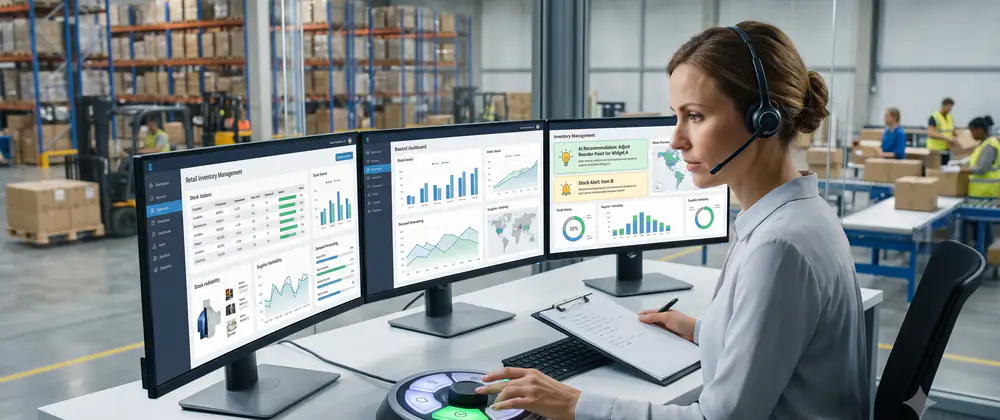
Today’s retail brands face intense pressure to make rapid, accurate stock decisions. However, operations teams naturally worry about handing complete purchasing or replenishment decisions over to an algorithm. Implementing AI for inventory management works best when you treat the technology as a practical decision-support tool rather than a hands-off replacement.
Applying AI technologies can pave the way for significant cost reductions and effective inventory management, provided you stay in control. This guide explores how to apply smart technology across your key stock workflows while keeping the firm boundaries you need to protect your cash flow, customer satisfaction, and supplier relationships.
Key Takeaways
- Smart technology should support your team with reliable data, leaving strategic, high-impact buying decisions in human hands.
- You can easily maintain complete oversight by setting up clear tiers of control: alerting, recommending, automating, and keeping decisions human-led.
- Practical starting points focus on repeatable tasks, such as flagging demand exceptions, sending stockout alerts, and tracking supplier delays.
- Human approval remains essential for large purchase orders, markdown plans, and any decisions that directly impact your company’s cash flow.
What Is AI in Inventory Management?
AI in inventory management uses advanced computing technologies, including machine learning, predictive analytics, and natural language processing, to systematically analyze your inventory data. Instead of forcing your team to spend hours digging through static spreadsheets, AI inventory management software scans your historical sales data, open purchase orders (POs), customer returns, supplier lead times, and current inventory levels to pinpoint patterns that are otherwise easy to miss. This modern approach is transforming inventory management by replacing guesswork with mathematical precision.
By utilizing AI inventory management tools, businesses can accurately forecast demand and easily monitor stock levels in real time. In practice, these inventory management systems evaluate your inventory data, historical sales data, and sales data alongside external factors and market trends to help you predict future demand. The system then translates this complex analysis into clear, practical outputs like accurate demand forecasts, draft purchase orders, or automated replenishment recommendations.
You do not need to fully automate your retail operations to benefit from these tools. For most growing brands, artificial intelligence works best as a supportive guide. It serves as a core layer for inventory optimization and supply chain optimization, helping your planners and buyers achieve optimal stock levels with speed and confidence. When you view technology this way, you can easily decide exactly where your business will benefit from automated alerts, where you want recommendations, and where you must keep decisions entirely human-led.
What Does It Mean to Use AI in Inventory Management Without Losing Control?
Maintaining control simply means setting clear boundaries around what your software can do on its own and what still requires a human signature. Because retail inventory management and your overall supply chain operations directly impact your cash flow, supplier relationships, and fulfillment promises, letting an algorithm purchase stock automatically is a major business risk.
A controlled inventory strategy uses AI systems to surface critical insights while reserving the actual execution for your team. This collaborative approach leverages AI in inventory to streamline your inventory management processes and gives your people the time and clarity to answer essential operational questions:
- Which of your product lines are at risk of selling out during your busiest seasons?
- Which automated demand forecasting models need a manual adjustment before you place an order?
- Which slow-moving Stock Keeping Units (SKUs) are tying up too much of your working capital?
- Which supplier delays are likely to threaten your retail inventory management promises?
When you treat these systems as expert analytical assistants, your operations leaders and finance managers always retain the final say on the decisions that drive your business forward. This ensures you maintain optimal stock control and keep optimal stock levels at the forefront of your operational strategy.
The Three Levels of AI Control in Inventory Management
Deploying intelligent technology in your retail business is not an all-or-nothing choice. You can apply different levels of operational autonomy based on the risk, financial value, and complexity of each stock decision. By dividing your approach into three clear levels of control, you can safely scale adoption of your AI-driven inventory management technology at your own pace.
Use AI to Alert Your Team
Using technology strictly for alerts is the safest, lowest-risk way to explore and implement AI-powered inventory management. At this level, your software continuously monitors your stock levels and supply chain operations, flagging potential discrepancies, reducing the risk of human error without changing any data on its own. Your planners receive immediate notifications about stockout risks, sudden sales spikes, or changes in supplier lead times, keeping the actual response entirely in human hands. For example, if a key product line experiences an unexpected surge in customer demand, the system alerts your team so they can decide whether to adjust safety stock or contact backup suppliers.
Use AI to Recommend Actions
The next tier of control uses AI-driven inventory management to analyze your real-time data and suggest a specific path forward. Here, the system goes beyond flagging a problem; it evaluates potential solutions and presents a clear recommendation for your team to review. For instance, the system might notice a stock imbalance and suggest moving excess inventory from a slow regional warehouse to an active physical store. It might also draft a specific purchase order to optimize stock levels before a major promotion. Because your team must manually approve the suggestion before anything happens, you get the key benefits of deep data analysis and predictive analytics without risking unauthorized purchasing commitments.
Use AI to Automate Routine Decisions
You should reserve full automation for low-risk, highly repeatable processes with very clear boundaries. In these scenarios, your software operates independently within the strict limits you define. For example, you might allow the system to automatically save draft POs when inventory drops below safety stock levels, or route incoming orders based on location availability. To keep your operations secure, these workflows must include robust exception handling. If a recommendation falls outside your set parameters, such as a bulk order exceeding your seasonal budget, the system immediately pauses the action and flags it to a manager for manual approval.
Inventory Workflows Where AI Can Help Your Team
Adopting new technology is not about chasing generic features. It is about strengthening the daily routines that keep your retail brand profitable. Integrating automated intelligence into specific workflows can help your team make faster, more consistent decisions.
Demand Forecasting and Exception Review
Traditional forecasting often struggles to keep up with sudden market changes, leading to costly stockouts or bloated carrying costs. By using machine learning models and algorithms, AI systems analyze your sales history, customer preferences, seasonal demand, and multi-channel marketing campaigns to generate accurate demand forecasts. This system supports your inventory planners by automatically flagging low-confidence projections or unusual demand shifts for close manual review, which dramatically improves your forecasting accuracy. Your team’s judgment remains essential for new product launches or major promotions where historical data is lacking, ensuring your business strategy always guides your purchasing decisions.
Stockout Alerts
Failing to keep popular items in stock directly hurts customer satisfaction and drives buyers to your competitors. An intelligent AI system monitors your sales velocity, open orders, and supplier lead times in real time to calculate exactly when an item is likely to sell out. Planners receive early warnings, giving them time to monitor stock levels, expedite shipments, adjust marketing campaigns, or transfer stock between locations to maintain optimal stock levels. Your team retains the ultimate authority to decide whether to reorder based on margins and current supplier relationships, preventing you from tying up cash in low-priority SKUs.
Replenishment Recommendations
Applying AI to inventory management helps you maintain optimal stock control by continuously comparing your current inventory levels with active sales data and vendor lead times. Instead of forcing your team to calculate reorder points manually in static spreadsheets, the system provides automated replenishment recommendations tailored to real-time sales patterns. This setup protects your business from blind ordering by presenting every suggestion directly to your procurement team for verification. High-value purchases or bulk orders that approach your cash-flow limits should always require manual sign-off, allowing you to optimize safety stock and minimize excess stock while ensuring your finance leaders maintain tight control over working capital.
Slow-Moving Stock Detection
Holding excess inventory drains your cash and inflates your inventory holding costs and carrying costs. AI tools identify slow-moving items early by comparing current sell-through rates with your historical sales patterns. The system can then suggest targeted actions, such as bundling slow SKUs with popular products, recommending strategic markdowns, or initiating cross-warehouse stock transfers. Your e-commerce and merchandising managers should always review these suggestions before execution to protect your brand image and overall margins, ensuring clearance strategies align with your broader retail operations.
Purchase Order Planning
Drafting individual purchase orders for dozens of suppliers is highly time-consuming and prone to manual errors. These AI inventory management tools simplify this planning by combining your precise demand forecasts, supplier minimum order quantities, and current stock levels to automatically create draft PO suggestions. Your purchasing team can quickly review these drafts, adjust quantities in line with negotiated vendor terms, and send them out with confidence. Setting up clear approval rules based on order value ensures your finance team retains complete oversight on large capital commitments, keeping your supply chain highly efficient but securely monitored.
Supplier Delay Monitoring
Unexpected shipping disruptions can quickly invalidate even the most accurate demand forecasts. AI tools continuously assess supplier lead times and historical vendor performance to flag potential delivery delays before they impact your warehouse operations. This predictive analytics layer helps your procurement team proactively decide whether to expedite, adjust safety stock, source from another supplier, adjust retail marketing plans, or change customer communications. Your human buyers must manage the actual supplier negotiations, as relationship management and contract terms require experienced judgment. Utilizing these predictive insights keeps your supply chain resilient.
Warehouse Coordination
Maintaining optimal stock control requires seamless communication between your front-end channels and back-end warehouse teams. AI supports warehouse management systems (WMS) and existing systems by analyzing order urgency and stock locations to optimize pick paths, group orders, and prioritize receiving tasks. This improves overall operational efficiency and reduces processing bottlenecks. Warehouse managers should always remain at the center of execution to resolve physical space constraints or sudden labor shortages, ensuring that automated workflows align with the real conditions on the warehouse floor. This balance of machine suggestion and human coordination keeps shipments moving smoothly.
Multichannel Inventory Allocation
Selling across e-commerce channels, marketplaces, physical stores, and wholesale accounts requires precise stock distribution to maintain high customer satisfaction. AI analyzes channel-specific sales velocity to recommend the optimal allocation of your inventory across your logistics network. This prevents you from overstocking one sales channel while starving another of popular items. Your operations leaders and e-commerce managers must supervise these transfers, as priority wholesale accounts or strategic retail locations often require manual adjustments that standard machine learning models cannot anticipate. This oversight guarantees that important partners remain happy.
What Data AI Needs to Make Trustworthy Inventory Recommendations
Your artificial intelligence tools are only as reliable as the quality of the underlying records they process. To generate trustworthy, actionable stock recommendations, your system must ingest consistent, real-time data from across your entire business to provide trustworthy inventory management solutions. Consolidating this inventory and sales data allows machine learning algorithms to reflect actual operational realities rather than generating flawed assumptions.
To achieve effective inventory management, the required data inputs include:
- Current Inventory Levels: To avoid costly errors, the system requires highly accurate stock counts across all warehouses, retail stores, and third-party fulfillment centers to dynamically optimize inventory levels.
- Historical Sales Data: Past transactions and sales data enable machine learning models to accurately identify seasonal demand patterns, customer preferences, and product lifecycles.
- Open Orders and Committed Stock: Knowing exactly which items are already promised to customers versus what is available to sell prevents double-selling.
- Supplier Lead Times: Accurate records of how long vendors take to manufacture and ship products ensure reorder suggestions remain realistic.
- Purchase Order History: Evaluating past orders reveals vendor reliability trends and protects against chronic overbuying or underbuying.
- Returns and Cancellations: Tracking return rates helps identify product quality issues, sizing inconsistencies, or sudden drops in demand.
- Warehouse and Fulfillment Capacity: Real-time data regarding receiving backlogs and labor constraints keeps replenishment recommendations aligned with actual processing capacity.
- Channel-Level Demand: Separate tracking of e-commerce, marketplace, and wholesale trends enables smarter, profit-focused stock allocation.
- Financial and Margin Records: Incorporating product costs, carrying costs, and open-to-buy budgets keeps automated suggestions aligned with your cash-flow limits.
What AI Can Automate, What Needs Approval, and What Should Stay Human-Led
To protect your business from human error and operational bottlenecks, you must establish a clear decision-making hierarchy. Classifying stock actions by risk helps your team identify which tasks can run in the background and which require experienced human eyes.
Low-Risk Tasks AI Can Automate
Routine, rule-based operations with clear parameters are prime candidates for full automation. You can safely delegate tasks such as generating low-value reorder alerts, updating internal dashboards with real-time data, and creating initial draft purchase orders for basic replenishment items. Automated order routing based on geographical stock availability also runs exceptionally well without manual oversight. Even with these automated workflows, your team must configure exception rules so that any sudden demand spikes or unusual order values are immediately flagged for human review.
Inventory Decisions That Should Require Approval
Decisions that directly impact your brand’s working capital, vendor relationships, or profit margins should always require human approval before execution. While AI can analyze historical sales data and suggest bulk purchase orders, safety stock adjustments for high-value items, or promotional markdown strategies, these suggestions must be validated by a planner or finance leader. Placing approval gates on transactions that exceed specific monetary thresholds helps keep your spending secure and manage your inventory holding costs. This hybrid model ensures your purchasing and inventory teams benefit from rapid data analysis while preventing costly automated errors during periods of demand variability. Having planners click to confirm ensures business context is always respected.
Strategic Decisions That Should Stay Human-Led
Strategic choices require market context, human negotiation skills, and brand alignment that mathematical models cannot replicate. Decisions such as launch planning for new product categories, vendor contract negotiations, and the definition of your overall holiday marketing strategy must remain entirely human-led. AI can certainly provide supporting analytical data, but final execution depends on your leadership team’s business experience and understanding of market trends, vendor contracts, and long-term brand strategy. Protecting this boundary guarantees that your brand’s unique identity, supplier relationships, and high-stakes financial commitments are never compromised by automated systems.
How to Build a Controlled AI Inventory Management Workflow
Successfully implementing AI for inventory management is less about choosing a generic software tool and more about redesigning your business workflows. By building a step-by-step process focused on control, you can integrate advanced technology without disrupting your active retail operations.
1. Choose One Recurring Inventory Decision
Avoid trying to transform your entire operation overnight. Instead, select one high-frequency, repeatable stock decision to focus on first, such as stockout alerts, slow-moving stock identification, or replenishment recommendations for a single product category. Starting small allows you to test the system’s accuracy and refine your processes before scaling.
2. Decide the Right Level of AI Control
Establish exactly how much autonomy the system should have. Decide whether the tool should simply alert your planners to a stock imbalance, recommend a specific transfer quantity, or automatically draft a purchase order. Base this decision on the risk, purchase value, and complexity associated with the target inventory. This ensures you never over-automate high-value items that require careful planning.
3. Define the Data the System Needs
Map out the specific data feeds required to make the workflow accurate. Ensure your system pulls clean, unified information, including current stock levels, historical sales records, and active supplier lead times. Fragmented or siloed data will inevitably lead to flawed recommendations that your team cannot trust, making centralized records and connected existing systems a core requirement.
4. Set Approval Rules and Exception Thresholds
Create firm guardrails to keep your operations secure. Configure your system to require manager approval for any purchase orders exceeding a specific dollar amount or for low-confidence forecasts. You should also establish escalation rules that route unexpected demand shifts directly to your finance or operations leaders, preventing automated systems from spending your budget without oversight. These rules act as a safety net for your cash flow.
5. Assign Ownership for Each Decision
Every automated output must have a designated human owner who is responsible for reviewing and acting on the insight. For example, assign your inventory planners to oversee reorder alerts while purchasing managers approve vendor adjustments. This clear ownership prevents valuable analytical recommendations from being ignored or falling through the cracks, maintaining accountability across your entire team.
6. Connect the Insight to the Next Workflow
An analytical recommendation is only valuable if your team can act on it immediately. Ensure your AI inventory tools are connected directly to your core software and purchasing systems. This connectivity allows an approved recommendation to instantly generate a purchase order or initiate a warehouse transfer without requiring slow, manual data reentry. Connected systems turn intelligence into swift, real-world execution.
7. Measure Whether Decisions Improve
Regularly evaluate your new workflow against key performance indicators (KPIs). Track critical metrics such as stockout frequency, forecasting accuracy, inventory turnover, carrying costs, and improved customer satisfaction. If you find the system consistently generating inaccurate recommendations, pause the workflow to audit your data quality and adjust your exception thresholds. Continuous monitoring ensures your technology remains an asset, not a liability, for your business.
Common Mistakes That Cause Retailers to Lose Control With AI
While integrating advanced technology offers substantial benefits, moving forward without proper safeguards can lead to costly operational disruptions. Avoiding common implementation errors helps your business maintain complete control over your stock, cash flow, and customer relationships. Understanding these pitfalls allows you to proactively design workflows that safeguard your brand’s capital and customer relationships.
Keep a close eye out for these frequent mistakes:
- Automating Too Much Too Quickly: Attempting to fully automate replenishment before establishing trust and validating your algorithms often leads to major over-ordering or severe stockouts.
- Neglecting Clear Approval Thresholds: Failing to configure purchase orders’ value and margin rules allows automated systems to draft or send high-risk orders without financial oversight.
- Relying on Fragmented Inventory Data: Running advanced models on disconnected spreadsheets or siloed systems forces the technology to make decisions based on inaccurate, outdated records, which undermines forecast accuracy.
- Ignoring Operational Constraints: Recommending stock replenishment without accounting for physical warehouse space, receiving capacity, fulfillment limits, or supplier lead times creates severe processing bottlenecks that disrupt your warehouse management systems.
- Overlooking Cash-Flow and Margin Limits: Approving recommendations based solely on demand velocity can quickly tie up precious working capital in carrying costs for low-margin goods, reducing your business’s agility.
- Viewing Technology as a Human Replacement: Treating algorithms as a substitute for experienced planners ignores the critical market intuition needed to navigate unexpected economic disruptions.
- Failing to Assign Decision Ownership: Allowing automated insights to accumulate in a dashboard without assigning specific team members to review them ensures critical opportunities are missed.
- Neglecting to Monitor Business Outcomes: Omitting regular performance audits can lead you to continue running inaccurate workflows that erode your bottom line.
How Brightpearl Helps Retailers Keep AI Inventory Workflows Connected and Controlled
To successfully use AI in inventory management without losing control, you need a powerful, centralized platform that serves as your single source of truth. Brightpearl is a trusted retail operating system by Sage designed specifically to unify your inventory, orders, purchasing, fulfillment, warehouse, and financial records. Rather than leaving your team to navigate disconnected dashboards and siloed tools, Brightpearl centralizes your complete inventory, sales, and order history data. This ensures that any AI-driven recommendations are always grounded in real-time, highly accurate business conditions across your entire retail operations.
By connecting your entire commerce network, Brightpearl provides unified inventory management solutions and turns analytical insights into controlled, actionable workflows. You can easily establish custom approval gates for purchase orders, monitor supplier lead times, and optimize your multi-channel stock allocation across e-commerce platforms, marketplaces, and physical retail locations. The built-in Automation Engine reduces repetitive manual entry, allowing your warehouse teams to coordinate picking, packing, and shipping with elevated consistency. With Brightpearl, your planners, buyers, and finance leaders maintain complete oversight, reviewing and approving recommendations through structured workflows that protect your margins and cash flow.
Are you ready to bring complete operational clarity and controlled automation to your retail brand? Book a Demo today to discover how Brightpearl can help you build a resilient, highly efficient inventory management system that scales with your growth.
Frequently Asked Questions About AI in Inventory Management
How Is AI Used in Inventory Management?
AI is used to continuously analyze real-time and historical data across your sales channels, warehouses, and suppliers. It helps retail brands maintain optimal stock levels by generating precise demand forecasts, flagging stockout risks before they impact customers, proposing replenishment quantities, and identifying slow-moving items. This integration transforms raw data into immediately actionable business insights.
Can AI Replace Inventory Managers?
No, AI is built to support inventory managers, not replace them. While machine learning algorithms excel at processing massive datasets to spot trends, experienced human judgment remains essential for strategic buying, supplier negotiations, launching new product categories, and responding to sudden market disruptions where historical patterns simply do not apply.
What Inventory Tasks Should Retailers Automate First?
Retailers should first automate low-risk, highly repeatable, rule-based tasks. Excellent starting points include generating reorder alerts, updating performance dashboards with live data, creating draft purchase orders based on preset safety stock levels, and routing orders based on location. This frees your team to focus on strategic, high-value operations.
How Can Retailers Stay in Control When Using AI for Inventory Management?
You can maintain complete control by setting strict approval rules, establishing spending thresholds for automated drafts, and designating clear human owners for every recommendation. Ensuring your team validates high-value orders, supplier changes, and strategic markdown decisions prevents automated systems from executing high-impact actions without direct human oversight.
What Data Does AI Need for Inventory Management?
To deliver trustworthy recommendations, AI systems require accurate, unified records of current inventory levels, historical sales patterns, active supplier lead times, open purchase orders, and returns data. Access to live, connected data across all sales channels and warehouses ensures recommendations remain realistic, actionable, and aligned with cash-flow limits.