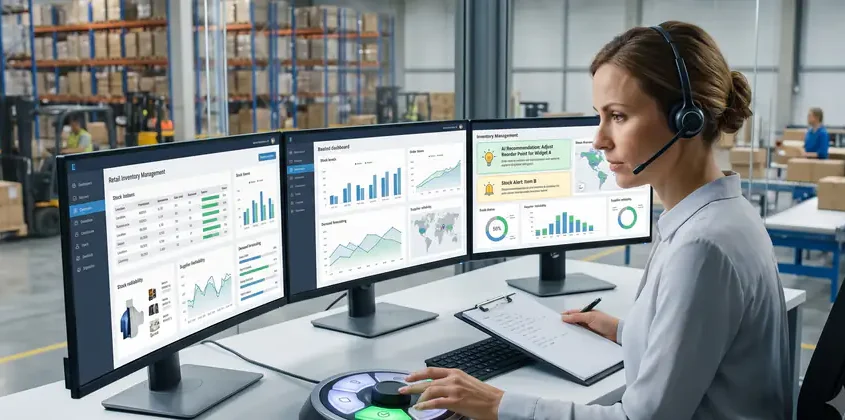
AI is no longer a concept confined to retail trade shows or future-looking slide decks. Today, leading retailers use these tools to make faster decisions, eliminate manual work, and deliver smoother customer experiences. This guide breaks down how AI in retail actually works, highlighting the practical applications that can help you run your business with greater precision.
Key Takeaways
- AI in retail is already helping brands improve practical, everyday operations, from demand forecasting and inventory planning to customer service, fulfillment, pricing, and reporting.
- The most effective AI use cases solve specific business problems, such as reducing stockouts, improving forecast accuracy, protecting margins, speeding up fulfillment, or creating more personalized customer experiences.
- AI tools depend on accurate, connected data. When inventory, orders, customer records, purchasing, and fulfillment data live in separate systems, AI-driven insights can become incomplete or unreliable.
- Retailers should keep humans involved in important decisions, especially when using AI for pricing, fraud reviews, vendor relationships, and customer interactions.
- Brightpearl helps retailers build the connected operational foundation AI needs by centralizing core data and workflows across inventory, orders, purchasing, fulfillment, warehouse management, and reporting.
What Is AI in Retail?
Retail AI refers to the use of intelligent systems, machine learning, and predictive analytics to uncover hidden patterns in your data and automate routine decisions. Instead of forcing your team to run manual calculations, these tools look at your past sales data and current trends to help you choose the right path forward.
Most AI software gathers data from across your operations, integrating your e-commerce platforms, point-of-sale (POS) systems, and inventory trackers. This connected data enables the system to assist with both customer-facing features and behind-the-scenes business operations.
Depending on your setup, you might use predictive analytics to forecast demand, generative AI to draft copy, or natural language processing to communicate with buyers. These advanced AI systems and tools analyze relevant data to predict future customer demand. For example, an AI tool can analyze sales velocity and localized market trends in the retail industry to warn your team that a popular item is likely to sell out well before your next regular shipment arrives.
Why AI Matters for Retail Brands
Modern retail businesses face a perfect storm of tighter margins and faster-moving consumer trends. When your team relies on disconnected systems and static spreadsheets, keeping pace with these changes becomes almost impossible.
These compounding pressures make AI technologies a critical tool for brands trying to navigate a challenging market:
- Rapidly shifting demand: Last year’s historical sales data is no longer enough to guide your inventory purchases when consumer trends shift overnight.
- The realities of omnichannel selling: Managing inventory, orders, and fulfillment across marketplaces, physical stores, and social platforms creates massive operational friction.
- Persistent margin pressures: Rising fulfillment costs, frequent supply chain disruptions, overstock waste, and payment fraud all make precision planning essential.
- Rising customer expectations: Today’s online shoppers expect personalized marketing offers, instant customer support, and lightning-fast delivery as a standard experience.
- The limits of manual work: Your best people should spend their time growing the business, not copy-pasting numbers across spreadsheet tabs.
These compounding pressures mean that automated solutions are becoming key tools for retailers seeking to remain competitive, optimize supply chain management, and scale their business operations efficiently.
Practical Applications and Use Cases for AI in Retail
Implementing artificial intelligence in the retail sector is most effective when you focus on solving specific operational bottlenecks rather than adopting technology for its own sake. When you target real business problems, AI tools can help your team improve speed, accuracy, and profitability across your entire organization.
Demand forecasting
Predicting future customer demand can feel like aiming at a moving target, especially when consumer trends shift quickly. AI algorithms make this process much easier by analyzing transaction patterns, promotional calendars, and real-time market data simultaneously.
This predictive approach gives your company a clearer look at what will sell, helping your supply chain prepare for volume changes before they catch you off guard. Moving to this style of planning helps you protect your cash flow, reduce overstock, and keep your shelves filled.
For instance, an apparel brand can use predictive analytics to analyze local search trends, social media posts, and current sales velocity to forecast which colors and sizes will sell best at different store locations.
Inventory planning and replenishment
Keeping your inventory levels perfectly balanced requires constant attention, but machine learning models can lift much of this operational burden. These systems track stock across all your channels, analyze supplier lead times, and automatically calculate accurate reorder points.
Using automated inventory management keeps your capital moving, preventing your cash from getting trapped in slow-moving stock or lost to out-of-stock items.
For example, your planner might receive an automated alert from an inventory planning tool indicating that a fast-moving item will sell out in ten days, prompting an immediate reorder request. By keeping your operational data centralized in a retail management system, you guarantee that these planning calculations are based on real-time sales, accurate inventory levels, and up-to-date vendor data.
Personalized product recommendations
Online shoppers want to find what they need quickly, without scrolling through pages of irrelevant products. AI systems solve this by analyzing customer data, purchase history, and real-time browsing behavior to serve up tailored suggestions.
When you personalize customer experiences in this way, you improve the entire online shopping experience and build deeper customer engagement.
For example, an online beauty brand can use machine learning to recommend a specific moisturizer based on a customer’s purchase history and quiz responses. Delivering these targeted promotions through mobile apps or custom email campaigns keeps your brand top of mind and encourages repeat purchases.
Dynamic pricing and promotion optimization
Setting the right price is a delicate balance between driving sales volume and protecting your margins. AI tools make this easier by continuously evaluating competitor pricing, current inventory levels, and real-time customer behavior.
Using these tools to optimize pricing strategies helps you spot the perfect moment to run targeted promotions, allowing you to clear out older stock before it becomes dead inventory.
For instance, an outdoor brand might use AI to spot a competitor’s sudden price drop on a popular tent, triggering a recommendation to bundle that tent with a high-margin accessory. To protect your brand’s reputation, ensure your teams set clear rules and maintain human oversight of your pricing software.
AI customer service, chatbots, and agent support
Customer inquiries do not stop when your office closes, but AI-powered service tools can keep the conversation going. Using natural language processing, virtual assistants can answer simple customer queries, track packages, and process returns instantly.
Automating routine tasks like these keeps your customer satisfaction high while giving your support agents the freedom to handle complex, high-touch customer interactions.
For example, an AI agent connected to your retail customer relationship management (CRM) software can instantly look up a customer’s order history to draft a personalized response. Your store associates and support agents can then review, edit, and send the message, maintaining a perfect balance of speed and human care.
Merchandising and assortment planning
Great merchandising is as much about science as it is about art. AI analyzes your transaction patterns and search trends to show your team exactly which product categories, collections, and bundles perform best together.
For physical stores, you can even use computer vision to analyze customer behavior as they walk through your aisles, helping you optimize store layouts for better foot traffic.
For example, a home retailer might notice that shoppers who frequently buy a specific table set also look for matching glassware, prompting the team to create a digital bundle. Linking these insights to your purchasing workflows ensures you have sufficient stock to support your visual merchandising decisions.
Fraud detection and risk management
Online payment fraud can quietly erode your margins if your team is manually reviewing every suspicious transaction. Intelligent risk management tools solve this by running real-time transaction monitoring and instantly analyzing order profiles for high-risk signs.
This rapid analysis lets you spot fraud before you ship the products, reducing expensive chargebacks and protecting your hard-earned revenue.
For example, an AI system can flag a large order that pairs a domestic shipping address with a foreign IP address and hold it temporarily for a quick human review. Keeping your screening rules precise ensures you protect your business without accidentally rejecting honest online shoppers.
Warehouse automation and order fulfillment
A busy warehouse can easily become a major bottleneck if your picking, packing, and shipping steps are disorganized. AI-powered solutions solve this by grouping incoming orders, planning the most efficient picking paths, and predicting labor needs.
Improving your fulfillment coordination leads to faster shipping times, fewer packing errors, and a far more reliable delivery experience for your customers.
For example, a supervisor can use a warehouse management system to group orders by location, directing pickers along the shortest path. Using dedicated shipping and fulfillment software gives your warehouse the real-time data flow needed to keep orders moving smoothly.
AI-assisted reporting and anomaly detection
Traditional reporting tools often force your team to dig through static reports to find out why your sales or returns spiked. AI-assisted analytics tools change this by constantly scanning your data to automatically spot unusual trends, performance drops, or operational risks.
This proactive approach lets your operations team make fast, data-driven decision-making a natural part of their daily routine.
For example, your system might highlight a sudden increase in returns for a specific SKU, letting you catch a sizing or manufacturing error early. Setting up an integrated retail reporting and analytics system gives your analytical tools a clean, comprehensive look across your entire operation.
Benefits of AI in Retail
The real value of bringing AI into your operations is not about adding flashier technology to your stack. It is about using intelligent tools to achieve tangible, measurable improvements in how your retail brand runs every single day.
By building your AI tools on a connected operational foundation, your business can gain several key advantages:
- High-accuracy demand planning: You can purchase inventory with confidence by matching your stock levels to actual demand rather than relying on gut feelings.
- Healthy inventory cash flow: Automated inventory management helps you clear slow-moving goods and keep cash flowing, rather than tying it up in dead stock.
- Faster, more accurate fulfillment: Prioritizing and routing orders intelligently minimizes shipping delays, helping you meet customer expectations and improve satisfaction.
- Protected profit margins: Smarter pricing, early fraud detection, and optimized promotions work together to defend your bottom line.
- More productive teams: Automating routine tasks and heavy spreadsheets gives your staff more space to focus on projects that actually drive growth.
- Deeper customer loyalty: Offering fast support, accurate stock levels, and relevant suggestions makes the entire online shopping experience feel seamless.
Ultimately, these advantages help your business build a more agile, resilient operation that can scale confidently without constantly adding to your team’s manual workload.
Common Challenges Retailers Face With AI
While the potential is clear, implementing AI successfully is rarely a simple, hands-off process. Many retail businesses run into issues when they try to adopt advanced analytical software without fixing the foundational systems that feed those tools.
If you are planning to bring AI into your business, keep these common challenges in mind:
- Disconnected operational data: AI models need a complete view of your business to work. If your inventory, order history, and customer records live in separate systems, your insights will be incomplete.
- Inconsistent data quality: If your product listings, stock records, or supplier details are outdated, your AI tools will make poor replenishment decisions.
- Unclear business goals: Starting with a vague desire to use AI is a recipe for frustration. You need to target specific problems, like reducing stockouts or lowering fulfillment costs.
- Privacy and customer consent: Using customer feedback, browsing behavior, and purchase histories for personalization requires a secure approach that complies with data privacy regulations.
- AI errors and biased outputs: Automated recommendations are not perfect and can occasionally produce incorrect forecasts or pricing errors if they are not monitored carefully.
- The risk of over-automation: Automating routine tasks is helpful, but some areas of your business require human empathy and strategic thinking. Relying entirely on automated systems for vendor relationships or complex support cases can hurt your brand.
- Change management friction: Your teams need to understand why the system makes certain recommendations, and they must feel confident adjusting or overriding those suggestions.
Understanding these potential pitfalls enables your leadership team to build a realistic roadmap, ensuring you have the right operational foundation to support your new systems.
How to Get Started With AI in Retail
You do not need to rewrite your entire operations plan or invest in a dozen different systems to begin using AI. The most successful retailers typically start with a focused, highly manageable project that addresses a specific operational bottleneck and delivers a clear return on investment.
1. Identify the business problem and success metric first
Start by targeting a specific operational bottleneck, like reducing your out-of-stock items or speeding up customer service responses. Define what success looks like with a clear metric, such as your forecast accuracy, return rate, or average ticket resolution time. Having a clear metric keeps your pilot project focused, helps you manage consumer demand, and makes it easy to demonstrate the tool’s value to your leadership team.
2. Audit your data and systems
Take a close look at where your operational data lives, checking for siloes between your e-commerce, point of sale, inventory, and accounting software. Look for duplicate customer records or outdated product catalogs that could throw off your new tools. Your data does not need to be flawless to get started, but you must identify the biggest gaps.
3. Start with one high-impact use case
Pick a single project where the value is obvious and easy to track, like dynamic pricing or automated demand forecasting. Trying to launch multiple AI tools at once will only confuse your team and make it harder to measure your actual results. A focused pilot project gives your operations team a chance to build trust in the software and refine their daily routines.
4. Keep humans in the loop
AI is a powerful assistant, but it should never replace the seasoned intuition of your retail teams. Your planners and merchants should always review automated suggestions, set clear rules, and override the system when unexpected events occur. This balance is especially important for sensitive decisions like dynamic pricing, fraud reviews, and direct customer interactions.
5. Build on a connected retail operations foundation
AI tools work best when they can access complete, real-time data from every part of your business. If your channels are disconnected, your forecasting and automated planning will struggle. A robust retail operating system helps you centralize your operational data, giving your AI systems the steady, accurate information flow they need to optimize retail operations.
How Brightpearl Helps Retailers Build the Foundation for AI
Brightpearl, a leading retail operating system from Sage, helps retail brands connect their core retail operations across inventory, orders, purchasing, warehouse management, fulfillment, and financial reporting. Instead of forcing your team to jump between disconnected software programs, Brightpearl gives you a single source of truth for your entire business.
Since AI models depend entirely on clean, high-quality data, having a unified operational foundation is critical. Brightpearl keeps your core data accurate and accessible, providing your planning and optimization tools with a reliable, real-time view of your stock, sales, and supplier times.
Using Brightpearl’s built-in automation engine lets you eliminate repetitive manual tasks, streamline order routing, and act on data analytics instantly. While Brightpearl is not a standalone AI platform, it provides the connected foundation that makes your AI tools and automated processes work flawlessly.
If you want to see how a connected foundation can prepare your business for smarter growth, book a demo with Brightpearl and explore our platform today.
Frequently Asked Questions
What is AI in retail?
AI in retail refers to the use of intelligent technologies such as machine learning, predictive analytics, natural language processing, and automation to streamline retail operations. These systems analyze historical and real-time sales data to help retail businesses optimize inventory, predict future customer demand, personalize marketing campaigns, and make faster, data-driven decisions.
How is AI used in retail?
Retailers use artificial intelligence across their entire business, from customer-facing personalization and virtual assistants to back-office supply chain management. Common practical applications include automated demand forecasting, real-time inventory planning, dynamic pricing strategies, automated fraud detection, optimized warehouse pick routes, and intelligent customer service ticketing that helps agents resolve queries faster.
What is the best first AI use case for a retail brand?
The best first use case is typically a focused operational problem with reliable, existing data and a clear success metric. Many brands start with predictive demand forecasting, automated replenishment, or basic customer service ticket routing, which allow teams to measure financial impact and build operational trust before expanding the use of technology.
What challenges should retailers expect when adopting AI?
Retailers often face challenges like disconnected data siloes, poor data quality, complex system integrations, and a lack of clear business goals. Additionally, teams must manage customer data privacy regulations, avoid over-automating sensitive tasks, and help staff adapt to new automated workflows through proper training and human oversight.
Do retailers need connected data before using AI?
While you can use individual, isolated AI tools, they become infinitely more powerful and accurate when built on connected data. Connecting your inventory management, sales channels, warehouse, and fulfillment workflows ensures your systems work with clean, real-time data, reducing errors and helping you achieve overall supply chain optimization.