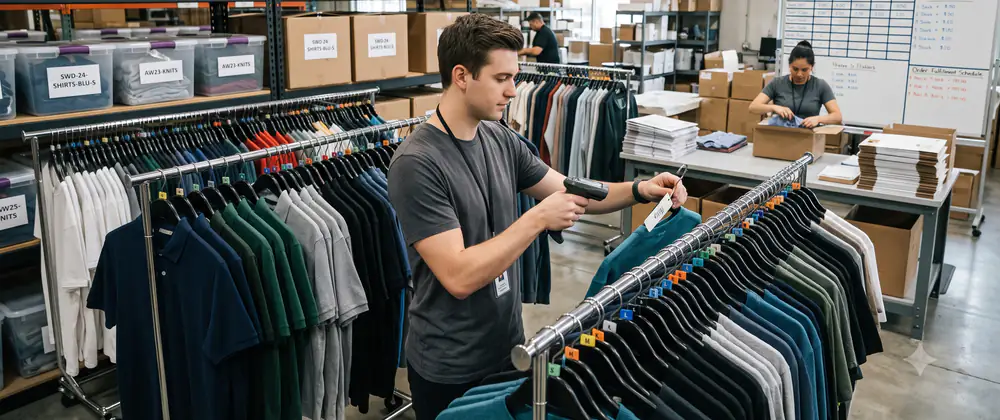
Clothing inventory gets harder to manage as your brand grows. Unlike standard retail stock, a single apparel design easily multiplies into dozens of variations when you factor in sizes, colors, and seasonal collections. Spreadsheets quickly fall apart once you expand across online channels, physical boutiques, and wholesale orders. This complete guide breaks down exactly how to manage your apparel inventory, protect your profit margins, and keep your customers coming back.
Key Takeaways
- Smart apparel inventory management balances customer demand against your storage limits, ensuring you keep popular sizes on hand without tying up cash in slow-moving items.
- Apparel stock is uniquely complex to organize because every individual garment requires variant-level tracking across size, color, fit, and style.
- Real-time visibility across all storage locations is your best defense against overselling, unexpected stockouts, and broken size runs.
- Centralizing your inventory processes with the best inventory management software allows you to optimize reorder points, reduce excess inventory, handle returns quickly, and automate stock allocation.
What Is Clothing Inventory Management?
Clothing inventory management is how you control your stock from the moment you purchase materials or finished goods to the second they land in a customer’s hands—and even when they come back as a return. But in the fashion world, controlling inventory involves far more than just counting boxes on a warehouse shelf. You need to know exactly which sizes, colors, and styles are sitting in your stockroom, on retail shelves, or with your third-party fulfillment partner.
For modern apparel companies, managing apparel inventory encompasses the entire supply chain. It begins with sourcing raw materials and managing production stages—often requiring specialized work-in-progress (WIP) inventory management—and continues with finished-stock inventory tracking to maintain optimal inventory levels. This is why variant-level tracking is so important. A clothing store might show plenty of inventory for a popular denim jacket, but if the small and medium sizes are sold out, you face immediate lost sales.
Real-time inventory visibility at the individual stock keeping unit (SKU) level across all of your online and physical channels helps prevent these blind spots. As your apparel brand grows, this discipline coordinates essential daily workflows like purchasing, warehouse tracking, multi-channel stock allocation, and returns. Setting up a reliable apparel inventory management system keeps your business running smoothly. It protects your profit margins by reducing excess stock, lowering storage costs, and keeping your customers happy with fast, accurate fulfillment.
Why Clothing Inventory Management Matters for Apparel Retailers
Managing your apparel inventory efficiently does more than just keep your warehouse tidy. It directly impacts your cash flow, customer retention, and your ability to grow. When you implement smart apparel inventory management strategies, you unlock several major advantages:
- Saves business cash flow: Strategic planning prevents you from buying too much seasonal stock, ensuring your money isn’t tied up in items you will have to discount deeply just to clear out.
- Reduces missed sales opportunities: Keeping stock levels aligned with actual sales trends means you always have the right sizes and colors on hand to meet customer demand.
- Speeds up order fulfillment: Accurate stock counts allow your warehouse teams, retail employees, and third-party logistics (3PL) providers to find, pack, and ship orders without delay.
- Improves your buying decisions: Clear visibility into your sell-through rates and historical sales data helps your purchasing team order exactly what sells, rather than relying on guesswork.
- Builds stronger customer trust: When your online stores and physical stores display accurate stock availability, customers enjoy a smooth shopping experience free from the frustration of canceled orders.
While these benefits are game-changing, achieving them is notoriously difficult in the fashion industry. Let us look at the specific hurdles that make apparel inventory a unique challenge to control.
Why Clothing Inventory Is So Difficult to Manage
Apparel retailers face unique inventory management challenges because customer preferences shift overnight and each product features multiple variations. Balancing short product lifecycles with unpredictable logistics requires constant attention.
High SKU Counts From Sizes, Colors, and Styles
A single dress or shirt design can translate into dozens of unique SKUs when you factor in every size, color, and fit option. This massive volume of variations makes it incredibly easy to end up with broken size runs, where you have plenty of extra-smalls and extra-larges left over, but absolutely nothing in the middle sizes your customers actually want.
Fast-Changing Seasonal Demand
The fashion calendar moves quickly, driven by seasonal launches, rapid trend cycles, and short promotional windows. A heavy wool coat that flies off the shelves in November becomes dead stock by April. This means you cannot rely on a single, static replenishment strategy for your entire catalog.
Overstock, Stockouts, and Markdown Pressure
Apparel brands constantly walk a tightrope between keeping enough safety stock to satisfy shoppers and overbuying. Ordering too many items ties up valuable warehouse space and forces you to run aggressive markdowns that quickly erode your profit margins.
Inventory Spread Across Multiple Locations and Channels
Modern clothing brands rarely sell in just one place. You likely sell through your e-commerce platforms, wholesale accounts, social marketplaces, and physical boutiques. If your inventory data isn’t unified, you run a high risk of selling an item online that a retail customer had already purchased hours earlier.
Returns, Exchanges, and Supplier Lead Times
Sizing and fit differences mean returns are a natural part of running an apparel business. However, returned items cannot be resold until they are unboxed, inspected, and processed back into your system. When you combine this delay with long supplier lead times and global supply chain disruptions, reordering a fast-selling item before demand disappears becomes incredibly difficult.
How Clothing Inventory Management Works
To gain true inventory control, it is helpful to view the inventory process as a continuous lifecycle. This step-by-step cycle guides your apparel from initial creation to final sales analysis, keeping your team perfectly aligned.
- Create and Categorize Product Records: Set up centralized product data by establishing unique SKUs, barcodes, and costs for every combination of style, size, and color in your clothing inventory management software.
- Order and Receive Stock: Create clear purchase orders for your suppliers, monitor incoming shipments, and inspect physical items carefully as they arrive at the loading dock.
- Track Inventory as It Moves: Use real-time inventory tracking to monitor product movement across multiple warehouses, retail shelves, and fulfillment centers via your warehouse management system.
- Forecast Demand: Analyze your historical sales data, seasonal patterns, and upcoming promotions to accurately predict how many items you will need for your next launch.
- Set Reorder Points and Safety Stock: Calculate the precise stock thresholds that should trigger a new purchase order, giving your suppliers enough lead time to prevent stockouts and maintain optimal stock levels.
- Allocate Inventory Across Channels: Strategically divide your available stock among your website, physical storefronts, wholesale clients, and online marketplaces.
- Fulfill Orders and Process Returns: Automatically update your stock counts across all sales channels as orders are shipped and returns are processed.
- Review Performance: Evaluate your inventory turnover, sell-through rates, and margins to spot your top performers and identify dead stock using retail reporting and analytics.
Clothing Inventory Management Terms to Know
Familiarizing yourself with standard industry terms makes it much easier to implement a successful stock strategy. Here is a quick glossary of the essential concepts you will encounter:
- SKU (Stock Keeping Unit): A unique code used to identify a specific product variation, such as a black crewneck sweater in size large.
- Variant: A distinct version of a product defined by its specific attributes, like size, color, fit, or fabric.
- Size Run: The complete spectrum of sizes produced and offered for a specific garment design.
- Broken Size Run: A scenario where popular sizes are completely sold out, leaving only extreme sizes that are difficult to sell at full price.
- On-Hand Inventory: The total physical stock currently sitting inside your warehouses, retail stores, or fulfillment centers.
- Available Inventory: The physical stock that is actually ready to be sold, excluding units already reserved for pending customer orders or wholesale commitments.
- Reserved or Allocated Inventory: Stock that has been set aside for specific orders, wholesale accounts, or specific sales channels.
- Incoming Inventory: Stock that has been ordered from your suppliers but has not yet arrived or been checked into your facilities.
- Stockout: An event where an item is completely unavailable for purchase because all stock has been sold.
- Overstock: Excess inventory that exceeds customer demand and sits idle in your warehouse, driving up storage costs.
- Dead Stock: Unsold clothing inventory that has reached the end of its season and is highly unlikely to sell without deep discounts.
- Sell-Through Rate: The percentage of received stock that you actually sell during a specific time period.
- Inventory Turnover: A metric that shows how many times your business sells and replaces its average inventory over the course of a year.
Clothing Inventory Management Best Practices
Successfully managing apparel stock requires moving beyond basic retail habits and embracing structured, data-driven workflows. These best practices build directly on your inventory lifecycle, giving your business the stability to scale while protecting your bottom line.
Use Clear Product Categories and SKU Structures
Clean, consistent data is the foundation of any successful retail business. Establish a logical SKU naming convention that incorporates style, color, size, and collection details in a predictable sequence. This standard structure makes it easier for your buying, warehouse, and customer service teams to identify products quickly, while preventing errors during replenishment and stock allocation. A clean data architecture also simplifies reporting. When your product details are structured correctly from the start, you can easily filter performance by fabric type, manufacturer, or designer, helping you spot emerging trends early.
Maintain Real-Time Inventory Visibility
Your stock counts must update immediately whenever a product is sold, returned, exchanged, or received. Achieving real-time inventory visibility across all sales channels prevents overselling on your website and helps you maintain customer trust. Relying on manually updated records often leads to shipping delays and costly cancellations when customer orders conflict.
Separate On-Hand, Available, Reserved, and Incoming Stock
Never treat your total physical stock as a single pool of available items. You must distinguish between stock that is physically present, stock that is actually available for purchase, and stock that is already allocated to outstanding orders. Keeping these categories separate ensures you do not accidentally oversell reserved units and allows you to manage your inventory allocation smoothly while integrating with your wider ERP system.
Forecast Demand by Product, Channel, and Season
Apparel sales are heavily influenced by weather, seasons, and fast-moving trends. Instead of applying a flat growth rate to your entire catalog, forecast demand at the SKU level, factoring in historical sales data and upcoming marketing campaigns. Remember that core, year-round basics require different demand forecasting models than short-lived, seasonal fashion drops.
Set Reorder Points for Core Products
Establish automatic reorder points for your evergreen styles to maintain optimal stock levels without manual intervention. Factor in supplier lead times, average daily sales velocity, and safety stock requirements to trigger purchase orders at the perfect moment. For highly seasonal or trend-led items, consider limiting reorders to avoid carrying excess inventory into the next fashion cycle.
Plan Purchases Around Cash Flow and Sell-Through
Buying teams must coordinate closely with finance to ensure inventory investments align with current cash flow constraints. Use your sell-through rate and inventory turnover metrics to decide which styles deserve replenishment and which should be phased out. Making purchases based on hard performance data reduces your reliance on late-season markdowns to clear slow-moving goods and helps you actively reduce excess inventory.
Allocate Stock Across Channels Carefully
If you sell through e-commerce, retail stores, and wholesale accounts, you must distribute your stock where it generates the highest margin and velocity. Track channel-specific demand to ensure you do not starve a busy physical storefront while excess stock sits idle in an online warehouse. Centralizing this inventory allocation process prevents siloed stock and improves overall capital efficiency.
Improve Warehouse Accuracy
Operational errors in your warehouse can quickly undermine your entire supply chain. Implement barcode scanning, establish organized bin locations, and conduct regular stock audits, such as cycle counting, to keep physical counts aligned with your software. Every unrecorded stock transfer or packing error distorts your channel visibility, leading to unfulfilled orders and frustrated customers. Conducting a physical inventory check regularly ensures that human errors do not slip through the cracks.
Track Returns and Exchanges
High return rates are a natural part of the apparel industry, making a structured return-to-stock process essential. Quickly inspect returned items so they can be restocked and made available for sale while they are still in season. Analyze return reasons to identify recurring fit or quality issues that might indicate problems with a supplier or inaccurate product descriptions. This feedback loop helps your merchandising and buying teams make better decisions for future collections, reducing overall return rates and protecting your bottom line.
Key Clothing Inventory Metrics to Track
To evaluate the health of your retail operation, you must monitor specific performance indicators. Tracking these metrics regularly helps your management team make faster, data-backed decisions.
- Sell-Through Rate: This compares the amount of inventory you receive against what you actually sell over a set period. It helps you identify which collections are popular and which require markdown support.
- Inventory Turnover: This reveals how many times your average inventory is sold and replaced during the year. A higher turnover indicates healthy sales, while a low rate suggests too much cash is tied up in slow-moving stock.
- Stockout Rate: This measures how often products are unavailable when customers attempt to buy them, highlighting areas where your safety stock or reorder points need adjustment.
- Gross Margin by Product Category: Tracking margins at the product level reveals whether your pricing strategies and manufacturing costs are protecting your overall business profitability.
- Days of Inventory on Hand: This indicates how long your current warehouse stock is expected to last, based on recent sales trends, providing a clear window for purchase planning.
- Return Rate by Variant: Sizing and fit discrepancies can lead to high return rates. Monitoring this metric helps you pinpoint specific styles or suppliers that are causing inventory disruptions.
- Markdown Rate: This shows the percentage of stock sold at promotional prices. Keeping this low proves that your demand forecasting and buying plans are accurate.
- Size Availability Rate: This tracks whether your core size runs remain complete. Complete runs prevent the dreaded broken size run scenario that leaves your store with unsellable extreme sizes.
Common Clothing Inventory Management Mistakes
Even experienced apparel companies can fall into habits that quietly erode profitability and slow down operations. Recognizing these common errors is the first step toward building a more resilient supply chain.
- Relying on spreadsheets for too long: Spreadsheets cannot update in real time across multiple channels. Using manual sheets often results in double-selling, inaccurate stock counts, and significant human error as your sales volume grows.
- Treating all products the same: Standard basics, seasonal collections, and limited drops require completely different purchasing and replenishment strategies. Managing them with the same set of rules leads to overstocking seasonal items and selling out of core products.
- Planning only at the product level: Evaluating sales solely by style hides critical variant performance. You might believe a dress is selling well overall, but if all the medium and large sizes are sold out, you are losing potential revenue.
- Ignoring supplier lead times: Failing to account for manufacturing and shipping delays can lead to stockouts, even if your demand forecasting is highly accurate.
- Overlooking return rate data: Returns dramatically affect your available stock levels and resale windows. Ignoring this data means you might over-order stock that is already being returned in high volumes.
- Failing to separate stock statuses: When your team cannot distinguish among available, reserved, and incoming stock, you risk promising unavailable inventory to wholesale or e-commerce customers.
- Delaying markdowns on slow movers: Holding onto old, seasonal inventory for too long wastes warehouse storage space and locks up capital that could be reinvested in fresh, high-margin products.
- Operating with disconnected systems: Running separate platforms for your online stores, physical stores, accounting, and warehouse management creates data silos that make accurate stock tracking impossible.
How Software Helps With Clothing Inventory Management
As your apparel brand expands across channels and warehouses, manual stock coordination quickly becomes unsustainable. Dedicated, robust inventory management technology transforms these complex operational challenges into streamlined, predictable workflows.
Centralized Inventory Data
Modern clothing inventory software gives your team a single source of truth for stock levels across e-commerce platforms, physical stores, marketplaces, and third-party logistics providers. Instead of checking multiple systems, your buying and operations teams can view real-time data at the style, color, and size level from a single dashboard linked to your retail CRM.
Automated Stock Updates
When your software automates stock adjustments, your inventory levels refresh instantly across every sales channel after a sale, return, or stock transfer. This continuous synchronization eliminates the manual work of updating individual listings, keeping your stock counts accurate and preventing overselling.
Smarter Purchasing and Replenishment
Implementing apparel inventory software uses historical sales data and supplier lead times to generate accurate purchase order suggestions. This intelligence helps you maintain optimal stock levels of core basics while giving you the flexibility to plan seasonal buys without tying up valuable capital.
Connected Order and Fulfillment Workflows
When inventory tracking connects directly to order fulfillment, the system routes orders to the most appropriate warehouse or store based on proximity and stock availability. This unified workflow speeds up picking and packing, reduces shipping costs, and helps you process customer returns and exchanges with minimal delay. This connection ensures that when inventory leaves your warehouse, the decrease is registered across all channels instantly. This visibility is vital when using third-party logistics providers, as it keeps your external partners fully aligned with your internal records.
Better Reporting and Decision-Making
Advanced inventory management tools give you deep insight into your inventory performance, highlighting clear sales trends, sell-through rates, and markdown risks. These metrics help buying teams identify best sellers early and make timely decisions about slow-moving items before they become dead stock.
These capabilities demonstrate why growing apparel brands need more than a basic tracking spreadsheet. To truly unlock multi-channel growth, you need an integrated solution that centralizes inventory alongside your broader business operations. This is where a dedicated retail operating system like Brightpearl becomes invaluable.
Manage Clothing Inventory More Effectively With Brightpearl
Growing apparel brands need more than standard stock counters; you need a comprehensive retail operating system designed for the complexities of modern, multi-channel commerce. Brightpearl connects your inventory tracking directly with your sales channels, purchasing, warehouse management, shipping, accounting, and reporting workflows. This unified approach eliminates data silos and manual tracking errors that often limit the scaling of fashion brands.
By centralizing your operations, Brightpearl gives your team complete visibility over variant performance, multi-warehouse stock, and channel-specific demand. The powerful Automation Engine handles repetitive tasks such as order routing, stock allocation, and purchase order generation, all based on real-time sales trends. This reduction in manual work allows your team to focus on strategic growth, secure in the knowledge that your financial records automatically reconcile with your stock movements through integrated retail accounting software.
Whether you are navigating supplier disruptions, managing high volume returns, or expanding into wholesale, Brightpearl provides the infrastructure you need to protect your margins. Transitioning away from fragmented systems and spreadsheets gives your business the agility to meet customer demand and scale with confidence.
Ready to gain complete control over your apparel stock? You can book a demo with Brightpearl today to see how our retail operating system can streamline your entire supply chain.
Frequently Asked Questions
What Is Clothing Inventory Management?
Clothing inventory management is the operational process of tracking, controlling, and replenishing apparel stock. It coordinates the lifecycle of clothing from raw materials and supplier production through storage, multi-channel sales, fulfillment, and returns, ensuring retailers maintain optimal stock levels at the variant level. This detailed oversight prevents common inventory challenges such as dead stock and broken size runs, thereby directly supporting cash flow.
What Is the Best Way to Track Clothing Inventory?
The most reliable method is using real-time inventory management software that integrates with all your sales channels, warehouses, and fulfillment centers. This ensures your stock counts, including specific sizes, colors, and styles, update automatically whenever a transaction or return occurs. Relying on a centralized management system removes the manual work of consolidating spreadsheets and drastically reduces the risk of human error.
How Do Clothing Retailers Avoid Overstock?
Apparel brands can prevent excess inventory by utilizing accurate demand forecasting, analyzing historical sales data, and setting dynamic reorder points. Monitoring your sell-through rate and inventory turnover also helps buying teams avoid purchasing too many units of highly seasonal or trend-dependent products. Additionally, planning promotions and coordinating markdown strategies early on prevents old inventory from occupying expensive storage space.
How Do You Manage Inventory Across Different Sizes and Colors?
Effective variant management requires establishing clear, structured SKU formats and using a centralized system that tracks stock at the style-color-size level. This level of detail ensures you spot broken size runs early and keep your physical and online store listings accurate. Implementing barcode scanning during receiving and picking also guarantees that warehouse workers retrieve the exact variants ordered, maintaining high order accuracy.
When Should a Clothing Retailer Move Beyond Spreadsheets?
You should transition away from spreadsheets once your brand expands to multiple warehouses, starts selling on multiple channels, handles wholesale orders, or experiences high return volumes. Manual updates cannot scale with this complexity, leading to overselling and shipping delays. When your administrative time is dominated by correcting stock discrepancies rather than driving growth, it is a sign that you need dedicated inventory software.