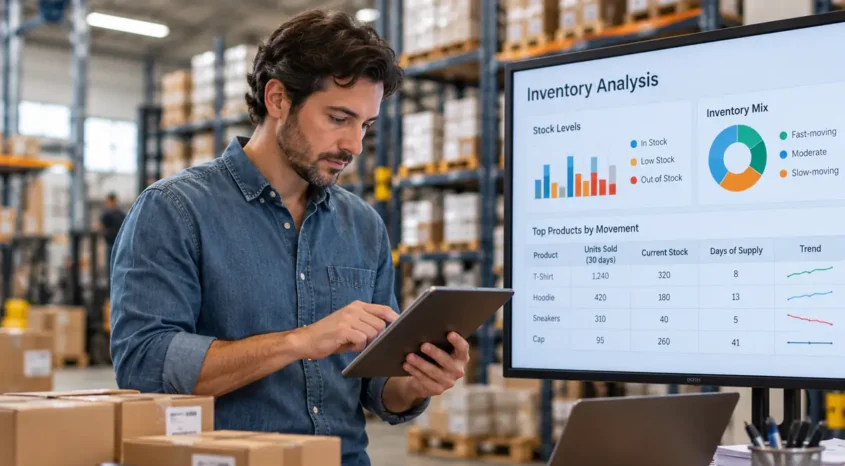
A company’s finished goods inventory is one of the most important assets it holds. These are the products that can generate revenue immediately, making them essential for both financial health and customer satisfaction. The amount of finished goods on hand influences cash flow, operating costs, and the ability to respond quickly to market demand.
When managed well, finished goods inventory ensures that customers receive their orders without delay while helping businesses avoid unnecessary expenses from excess stock. When managed poorly, it can tie up capital, create storage challenges, and limit growth. Understanding its role is the first step toward building a stronger and more profitable operation.
What is Finished Goods Inventory?
Finished goods inventory refers to products that are complete, ready for sale, and waiting to be delivered to customers. These items have already moved through the production process, from raw materials to work-in-progress, and now stand as the final stage of inventory.
Finished goods inventory examples include:
- Appliances that have been assembled, tested, and packaged by manufacturers.
- Bulk shipments of clothing or electronics prepared by wholesalers.
- Products on store shelves or listed online by retailers.
In every case, finished goods inventory refers to items that can generate revenue as soon as an order is placed.
Understanding finished goods inventory is vital because it directly connects to profitability and customer satisfaction. Unlike unfinished stock, which still requires labor and materials, finished goods are classified as current assets on the balance sheet. Finished goods inventory value is measurable and can be quickly converted to cash through sales.
Finished goods inventory also reveals how well a business manages supply and demand:
- Excess stock may point to overproduction or weak sales.
- Low stock may indicate missed opportunities and potential shortages.
By distinguishing finished goods from raw materials and work-in-progress, companies gain a clearer view of where resources are invested. This insight allows them to make smarter decisions about production, storage, and sales.
Why Finished Goods Inventory Matters
The finished goods inventory process is essential to the success of both manufacturing companies and retail stores. It determines how quickly a business can respond to customer demand and how efficiently it uses its resources. Regularly reviewing and optimizing a company’s finished goods inventory is essential to ensure efficient use of resources and maintain responsiveness to market changes.
Meeting Customer Demand
Tracking finished goods inventory allows companies to understand exactly what they have available for sale at any given time. This information helps them gauge how large an order they can accept and fulfill. For example, if a parent calls an electronics store to ask if a gaming console is available for their child’s birthday, a reliable finished goods inventory system can provide the answer instantly. It can also show how many units are in stock and whether another location has additional inventory. Failing to maintain adequate finished goods inventory can result in lost sales opportunities and dissatisfied customers.
Planning and Forecasting
Studying finished goods inventory value and levels over time reveals sales patterns and seasonal fluctuations. Businesses can use this information to anticipate demand spikes, avoid shortages, and reduce overstocking. By analyzing finished goods inventory data, companies can forecast demand and adjust production schedules to better align with future needs. This type of planning also improves cash flow management by highlighting which products sell quickly and which tend to remain unsold.
Inventory Turnover as a Performance Indicator
Finished goods inventory turnover is an important KPI that measures how long it takes to sell through available stock. A faster turnover rate usually indicates healthier sales and less cash tied up in inventory. A slower turnover, on the other hand, often means products are sitting too long, leading to higher storage costs, potential obsolescence, or damage.
Impact on Profitability
The longer items remain in finished goods inventory, the more they cost a business. Carrying expenses such as storage, insurance, and taxes rise over time, while the risk of unsold or outdated goods increases. Efficient management keeps these costs low, helps preserve margins, and makes operations more sustainable.
How to Calculate Finished Goods Inventory
Finished goods inventory is tracked across accounting periods, which means businesses need to know both the beginning balance and the ending balance for each cycle. Understanding how these finished good inventory formulas work together helps companies see how inventory is moving through production and sales.
The Finished Goods Inventory Formula
The standard way to calculate finished goods inventory is:
Finished Goods Inventory = Beginning Finished Goods Inventory + Cost of Goods Manufactured – Cost of Goods Sold
Using this formula to calculate finished goods inventory shows how much remains unsold at the end of a given period. Because of this, it is often called the ending finished goods inventory formula. Whether referred to as the general formula or the ending finished goods inventory formula, it represents the same calculation.
Beginning Finished Goods Inventory Formula
While the ending finished goods inventory formula is not overly complicated, the process to calculate finished goods inventory at the beginning of a period is even easier. There is no need to looks into the cost of goods sold or the cost of goods manufactured for this step. The beginning inventory is simply equal to the ending balance from the previous period.
Written out, the beginning inventory finished goods formula would look like this:
Beginning Finished Goods Inventory = Ending Finished Goods Inventory (from the prior period)
This rollover of ending inventory into beginning inventory ensures continuity from one period to the next and provides the starting point for the current period’s calculation.
Example: Connecting the Finished Goods Formulas
Imagine a business that sells home appliances. That business determines its cost of goods sold and cost of goods manufactured, and is now ready to determine its finished goods inventory. Here is how that business would calculate finished goods inventory value over two months, taking both ending inventory and beginning inventory into account:
March
- Beginning finished goods inventory: $30,000 (carried over from February)
- Cost of goods manufactured: $80,000
- Cost of goods sold: $70,000
Finished goods inventory calculation:
30,000 + 80,000 – 70,000 = 40,000
March ends with $40,000 in recorded finished goods inventory on the company’s balance sheet.
April
- Beginning finished goods inventory: $40,000 (carried over from March’s ending balance)
- Cost of goods manufactured: $100,000
- Cost of goods sold: $90,000
Calculation:
40,000 + 100,000 – 90,000 = 50,000
April ends with $50,000 in recorded finished goods inventory on the company’s balance sheet.
The Finished Goods Manufacturing Process in the Supply Chain
Finished goods inventory does not exist in isolation. It is the final outcome of the broader manufacturing process and the movement of goods through the supply chain. Understanding how raw materials become finished goods is essential for handling and tracking finished goods inventory effectively.
- Raw materials inventory is purchased and stored until production begins. This includes everything from fabric for clothing to steel for appliances.
- During the production process, raw materials are combined with direct labor costs and overhead to create partially completed products. These items are classified as work-in-progress inventory.
- Once the manufacturing process is complete, the products move into finished goods inventory, where they are ready for sale. At this stage, the total manufacturing cost includes raw materials, direct labor costs, and overhead expenses.
- When the products are sold, they become part of goods sold on the company’s financial statements. The associated expenses are recorded as cost of goods sold, which directly affects profit margins.
Using inventory management software allows businesses to track each of these stages in real time. By connecting raw materials inventory to finished goods, companies can see the complete flow of goods through the supply chain. This visibility makes managing finished goods inventory more accurate and efficient.
Common Challenges with Finished Goods Inventory
Managing finished goods inventory requires balancing many moving parts. Products need to be available when customers want them, but they also need to move through warehouses efficiently without sitting idle for too long. Companies that struggle with this balance often encounter a set of common challenges that impact both profitability and customer satisfaction.
Excess Stock and Overproduction
When production outpaces sales, finished goods pile up in warehouses. This ties up cash in unsold items and leads to higher storage costs, insurance fees, and potential obsolescence. For seasonal businesses, excess stock can quickly become outdated and difficult to move.
Stockouts and Lost Sales
The opposite problem is just as damaging. If finished goods run too low, companies cannot fulfill orders on time, which frustrates customers and pushes them to competitors. Consistently running out of stock also weakens a company’s reputation for reliability.
Complexity Across Multiple Channels
Retailers and wholesalers that sell through several channels, such as online stores, marketplaces, and physical locations, face additional difficulty. Keeping finished goods inventory synchronized across these outlets requires visibility and coordination. Without the right system in place, discrepancies are common.
Poor Forecasting
Finished goods inventory depends heavily on demand forecasting. If forecasts are inaccurate, companies either overproduce or underproduce. Both outcomes hurt cash flow and lead to operational inefficiencies.
Reliance on Manual Processes
Businesses that rely on spreadsheets or manual counts often deal with errors and delays. These mistakes distort the true picture of finished goods inventory, making it harder to plan production, purchasing, and sales effectively.
Best Practices for Managing Finished Goods Inventory
Finished goods inventory plays a major role in how a company serves its customers and manages profitability. When businesses approach it with the right strategies, inventory transforms from a cost burden into a competitive advantage. Strong practices create smoother operations, reduce unnecessary expenses, and ensure that products are available when customers are ready to buy. The following steps provide practical methods for improving how finished goods inventory is managed.
1. Track Demand with Reliable Forecasting
Studying historical sales data provides insight into how customer demand shifts across seasons or promotional cycles. Using this information to forecast future sales prevents both overproduction and shortages.
- Identify seasonal peaks and troughs.
- Incorporate market trends and customer behavior.
- Adjust forecasts regularly based on real-time sales.
2. Maintain Safety Stock
Safety stock acts as a buffer against unexpected demand or supply chain delays. The right amount depends on how quickly goods can be replenished and how volatile demand tends to be.
- Calculate safety stock based on lead times and sales variability.
- Review levels frequently to avoid unnecessary carrying costs.
3. Monitor Inventory Turnover
Inventory turnover measures how quickly products move from finished goods into customer hands. High turnover usually signals healthy sales, while low turnover suggests cash may be tied up in slow-moving stock.
- Compare turnover rates across different product categories.
- Prioritize replenishment of fast-selling items.
- Identify goods that need discounting or promotional support.
4. Optimize Warehouse Space
The way finished goods are stored affects both costs and efficiency. Poorly organized warehouses increase the risk of errors and slow down fulfillment.
- Use layout strategies such as slotting fast movers in accessible areas.
- Consolidate excess stock to free up storage space.
- Review storage costs to ensure they align with sales velocity.
5. Perform Regular Audits and Reviews
Physical audits and system checks ensure records match reality. Discrepancies between reported and actual finished goods inventory can distort forecasts and financial statements.
- Schedule routine cycle counts.
- Investigate and resolve inconsistencies quickly.
- Use audit data to improve accuracy in future reporting.
6. Automate Manual Processes
Automation reduces the errors and delays that come with spreadsheets and manual counts. Modern systems update inventory in real time as sales occur, giving teams instant visibility into stock levels.
- Automate order processing and reordering.
- Connect sales channels and warehouses for synchronization.
- Reduce reliance on manual data entry.
7. Use Inventory Insights for Better Decisions
Finished goods inventory data should feed into larger business strategies. It informs purchasing, production planning, and even marketing campaigns.
- Analyze which goods move fastest and adjust production accordingly.
- Identify products with consistently low demand to avoid waste.
- Use insights to balance total inventory value against cash flow goals.
How Brightpearl Helps Manage Finished Goods Inventory
Brightpearl is designed to simplify finished goods inventory management and reduce the costs that come with holding and moving stock. Its features give businesses real-time control and insight so they can serve customers efficiently and protect profitability.
- Real-time visibility across all channels: Inventory levels update instantly as sales occur, so businesses always know exactly how much stock is available and where it is located. This prevents overselling and ensures accurate order fulfillment.
- Smarter forecasting with historical sales data: Brightpearl uses past sales patterns to anticipate future demand. This helps businesses plan production, set safety stock levels, and reduce the risk of tying up cash in unsold items.
- Automation of routine tasks: Reordering, allocation, and fulfillment can all be automated through Brightpearl. This removes the errors and delays of manual processes while freeing up staff to focus on growth and strategy.
- Detailed inventory reporting: Brightpearl provides insights into turnover rates, sales velocity, and the total value of finished goods. Businesses can identify fast movers, slow sellers, and the impact inventory has on cash flow.
- Seamless integrations with other systems: By connecting with e-commerce platforms, marketplaces, accounting software, and shipping providers, Brightpearl ensures that finished goods inventory data flows smoothly across the business. This creates consistency from financial reporting to customer updates.
With these features working together, Brightpearl helps businesses manage finished goods inventory with accuracy, speed, and confidence.
Start Improving Your Finished Goods Management Today
Finished goods inventory plays a defining role in the success of both manufacturers and retailers. When managed with care, it improves cash flow, supports smarter planning, and creates a smoother experience for customers. When neglected, it can quietly erode profitability through higher costs and missed sales.
Brightpearl gives businesses the tools to bring order and efficiency to finished goods inventory management. Its visibility, automation, and reporting features reduce holding costs and help companies respond to demand with confidence. Book a demo today to see how Brightpearl can simplify your operations and strengthen your bottom line.