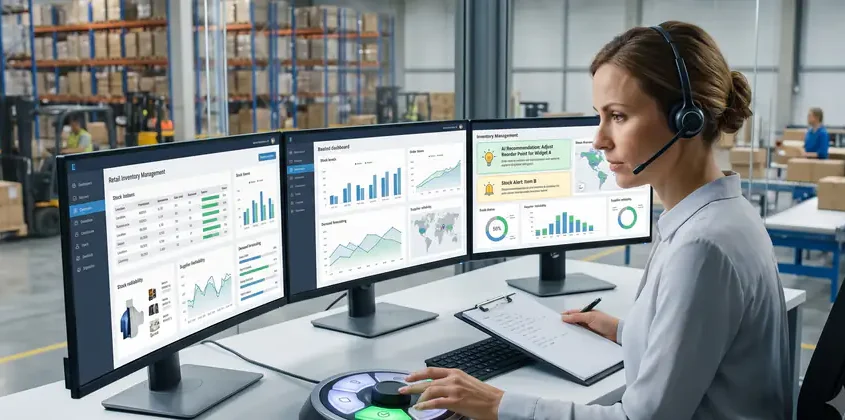
Warehouse automation has become a turning point for retailers trying to keep pace with growing demand. Manual processes slow the movement of goods, while automated warehouse systems handle repetitive tasks with consistent accuracy. The change frees warehouse workers to focus on decisions that keep orders moving, helping warehouse operations avoid the bottlenecks that often appear during peak seasons.
Key Takeaways
- Warehouse automation reduces the strain of manual labor and helps warehouse operations run with fewer delays.
- Warehouse automation systems support more accurate inventory activity, which improves order fulfillment and reduces human error.
- Retailers gain steadier movement across the warehouse as automated tools and systems guide repetitive tasks with consistent precision.
- A warehouse automation system helps managers create and streamline processes that adapt more easily to changes in demand.
What Is Warehouse Automation?
Warehouse automation is the use of technology to carry out warehouse operations that once depended on manual labor. These types of systems handle repetitive tasks, update inventory activity in real time, and guide the movement of goods through an automated warehouse with steady accuracy.
Examples of warehouse automation technology include:
- autonomous mobile robots that move products through storage areas
- conveyor systems that reduce travel time and direct warehouse pickers
- automated guided vehicles that transport materials across the warehouse
- barcode scanners and radio frequency identification tools that help track inventory
- automated equipment designed to improve the flow of goods in storage and retrieval systems
This shift improves order fulfillment and strengthens inventory management while reducing the delays that emerge when manual efforts fall behind rising demand. Warehouse automation technology works alongside warehouse management systems and automated storage methods to maintain reliable activity on the warehouse floor and lower the risk of human error.
Types of Warehouse Automation
Warehouse automation encompasses a wide range of tools and approaches that help retailers manage warehouse operations with greater consistency. Some options for warehouse automation involve equipment that moves or stores products, while others rely on software that guides processes throughout the warehouse environment. Understanding the different types of warehouse automation helps retailers see how various automation solutions can improve movement, reduce mistakes, and streamline operations.
Physical Automation
Physical automation uses automated material handling equipment to move goods, manage storage, and maintain a steady product flow. Examples include conveyor systems, autonomous mobile robots that navigate the warehouse, and automated storage and retrieval systems that place and collect items with precision. These tools reduce manual labor and contribute to efficient operations during periods of heavy demand.
Digital Automation
Digital automation relies on software to guide warehouse processes with consistent speed and accuracy. Warehouse automation software and warehouse management systems work together to create automated workflows and optimize warehouse operations. Many retailers use digital automation to track inventory more accurately and connect automated storage and retrieval with existing systems.
Common Warehouse Automation Technologies
Modern warehouses rely on a wide range of automation technologies to keep products moving and reduce the strain created by manual processes. These tools improve accuracy, limit human error, and give warehouse operations the consistency they need during periods of high demand. Many of the systems below appear in both physical and digital automation workflows, and each one brings a different advantage to the warehouse.
Retrieval systems (AS/RS)
Retrieval systems (AS/RS) move items into and out of storage with precision. These automated storage and retrieval technologies help maintain steady movement in high-volume environments that rely on consistent placement and retrieval.
Goods-to-person systems
Goods-to-person technology reduces unnecessary travel by bringing items directly to workers. Conveyors, carousels, and vertical lift modules move products quickly, which shortens pick times and limits congestion in busy aisles.
Autonomous mobile robots
Autonomous mobile robots navigate the warehouse with onboard sensors and create their own routes. Their ability to detect obstacles makes them suitable for dynamic environments with frequent human traffic.
Automatic guided vehicles
Automatic guided vehicles follow fixed paths throughout the warehouse and transport products between stations. They function best in simple layouts with predictable movement and reduce the manual labor required for repetitive transport tasks.
Pick-to-light and put-to-light tools
These systems use lights and digital prompts to direct warehouse pickers to the correct locations. Clear visual cues reduce searching time and help maintain inventory accuracy during fast-moving workflows.
Voice-directed picking
Voice picking gives workers hands-free task direction through headsets and speech recognition software. This approach improves movement through the warehouse and removes the need to pause and check handheld devices.
Automated sortation systems
Automated sortation systems identify items on conveyor systems and route them to the correct destinations. Many warehouses connect sortation activity to transportation management systems so outbound shipments follow the right carrier and schedule. Companies use them during receiving, picking, packing, and shipping to keep order fulfillment steady.
The Benefits of Warehouse Automation Systems
Warehouse automation changes how work moves through a facility. Retailers who once relied on manual approaches see how fully automated warehouse systems keep inventory flowing, limit disruptions, and create conditions where warehouse operations can adjust to rising demand without slowing down. Automation also reduces the strain on workers, who gain more time to focus on decisions that influence product movement and customer outcomes.
Faster and More Consistent Fulfillment
Automation accelerates the path from storage to shipment. Items move through the facility with steady guidance from warehouse automation tools, which reduces idle time and gives order fulfillment a smoother rhythm during busy stretches. This momentum improves customer satisfaction as orders reach buyers more quickly and with fewer errors.
Better Use of Labor
Automated tools and equipment manage the recurring tasks that consume time and energy during busy periods. Human workers can step into roles that rely on judgment, problem-solving, and attention to detail, which strengthens the entire workflow.
Stronger Inventory Management
Inventory automation cuts back on human error in counting, locating, and updating stock. Inventory activity becomes more reliable, and managers gain a clearer sense of what needs replenishment and where items belong.
Lower Operational Costs
Automation trims labor costs during peak seasons and eases the pressure to hire large temporary teams. Warehouse automation systems work with a consistent pace, which reduces wasted movement and leads to measurable cost savings over time.
Scalability During Growth
Warehouse automation keeps performance steady even as order volumes rise. Retailers can grow without overloading warehouse processes because automation solutions maintain dependable movement and adjust to demand with fewer disruptions.
Common Challenges of Warehouse Automation
Warehouse automation can bring new momentum to a warehouse, but the transition often feels different from what teams expect. The shift introduces unfamiliar tools, changes long-standing routines, and pushes retailers to rethink how information moves between systems. Even when the benefits are clear, the path there can involve moments of friction as a facility adapts to a new rhythm and learns how automation fits into its day-to-day workflow.
Some common challenges with implementing warehouse automation include:
- Upfront investment in automated equipment or systems
- Process standardization must happen before automation performs reliably
- Integration work is required to connect automated storage and retrieval with existing software
- Training employees so they can use new tools with confidence
- Maintaining accurate data to prevent automated technologies from producing errors
Warehouse Operations That Can Be Automated
Automation can influence nearly every part of a warehouse, although most retailers begin with areas where mundane tasks or slow movement create pressure on the rest of the workflow. As new automation solutions take hold, these operations gain more consistency, fewer stoppages, and a steadier flow of information that helps warehouse managers make faster decisions.
Warehouse automation gives retailers a practical way to optimize operations across the activities that shape daily warehouse movement, including:
- Order routing and prioritization: Automation directs products to suitable paths, which keeps movement steady even when demand spikes.
- Pick list generation: Automated lists give warehouse pickers clearer guidance and reduce unnecessary travel.
- Inventory tracking tools: Barcode scanners and radio frequency identification equipment record item movement with greater accuracy.
- Guided picking paths: Navigation support helps workers move through the warehouse with fewer interruptions.
- Automated packing steps: Systems prepare shipping labels and related documentation without slowing the flow of orders.
- Real-time stock adjustments: Automated updates strengthen inventory accuracy and reduce the chance of human error.
- Automated supplier ordering: Inventory management systems trigger replenishment as stock reaches defined thresholds.
- Exception handling workflows: Automation flags unusual activity so warehouse managers can intervene quickly.
- Returns and restocking rules: Structured routines keep products moving back into storage space without disrupting nearby warehouse processes.
How to Implement Warehouse Automation
Introducing automation into a warehouse works best when the rollout follows a structured plan. Each step builds on the last, which helps warehouse managers avoid unnecessary disruptions and gives employees time to adapt to new tools and automated processes. A thoughtful approach also ensures that new warehouse automation solutions align with existing software systems and improve operations rather than complicate them.
- Identify operational bottlenecks: Look for warehouse processes that slow movement, rely heavily on manual labor, or create recurring delays.
- Audit data accuracy: Automated warehouse systems rely on clean, consistent information, so product and location data should be verified before automation takes hold.
- Standardize workflows: Clear, repeatable routines make it easier for automation systems to perform tasks with accuracy.
- Choose technology that fits your goals: Consider automated equipment, warehouse automation technology, or digital automation tools that match your operation’s size and complexity.
- Roll out automation in stages: A phased approach reduces risk and gives teams time to understand how new systems influence daily activity in the warehouse.
- Monitor performance: Warehouse automation systems reveal trends that might go unnoticed in manual work, which helps refine routines and maintain operational efficiency as demand changes.
Warehouse Automation Best Practices
Retailers that approach warehouse automation with a long-term mindset often see smoother performance and fewer setbacks. These practices help automated systems stay reliable, reduce human error, and maintain efficient operations as warehouse processes evolve.
Keep Data Accurate
Clean and dependable product, supplier, and location data give automation systems the information they need to function without interruption. Strong data habits reduce confusion, prevent misrouting, and help warehouse managers avoid errors that slow movement.
Start With Manageable Workflows
Beginning with smaller automation solutions allows teams to learn how automated processes influence daily activity. This approach makes it easier to refine routines and expand into more complex areas once the initial workflows perform consistently.
Use Exception Rules to Catch Problems Early
Exception alerts help identify issues that require human judgment before they turn into disruptions. These signals keep operations steady and give managers a chance to adjust quickly when something unexpected appears.
Train Warehouse Workers Early and Often
Training prepares teams for new responsibilities and reduces hesitation when automated systems take over certain tasks. Workers gain confidence as they learn how automation changes movement across the warehouse.
Review and Revise Workflows Regularly
Warehouse needs shift over time, especially as demand patterns, product lines, and automation solutions evolve. Routine reviews ensure workflows remain aligned with operational goals and prevent outdated habits from limiting performance.
Emerging Warehouse Automation Trends
Warehouse automation is moving fast, and retailers are discovering new ways to keep products flowing with fewer interruptions. Many of the latest warehouse automation trends push automation beyond basic task handling and into broader decision-making, real-time coordination, and smarter movement across the warehouse. These shifts show how warehouse automation is becoming a driving force behind more flexible, responsive operations.
Smarter automation shaped by machine learning
Machine learning gives automated systems the ability to recognize patterns in demand, picking behavior, and product movement. As these tools get smarter, they help managers react sooner, route goods more efficiently, and maintain steadier activity during peaks that would overwhelm manual approaches.
Rapid adoption of autonomous mobile robots and warehouse drones
Autonomous mobile robots are taking on more responsibility as navigation improves and sensors grow more precise. Warehouses are also testing drones for cycle counts and other routine work that normally drains time. Both technologies increase visibility into inventory activity and reduce the pressure placed on workers.
Stronger reliance on automated sortation and conveyor-driven movement
Automated sortation systems now play a bigger role in facilities with large product catalogs or fast-changing order profiles. These advanced technologies keep items moving even when human traffic is heavy, which helps maintain momentum during busy seasons.
Predictive maintenance becoming a standard expectation
Instead of waiting for equipment failures, warehouses now rely on predictive maintenance tools that monitor performance and highlight signs of wear. This approach prevents unplanned downtime, lowers the need for ongoing maintenance, and protects the efficiency gains created by system automation.
Greater connection between digital and physical systems
Warehouses are moving toward environments where digital tools and warehouse management systems communicate without friction. Better integration reduces gaps between receiving, picking, packing, and shipping, creating a workflow that feels more unified and easier to control.
How Brightpearl Supports Successful Warehouse Automation
Brightpearl gives retailers a faster and more dependable way to move products through the warehouse. Its platform links sales, fulfillment, and inventory activity in real time, so warehouse operations stay aligned even as order volume shifts. Once automation takes hold, routines feel smoother, and workers spend more time keeping orders in motion instead of managing manual updates.
- Automation Engine workflows: Brightpearl automates a wide range of order tasks and reduces repetitive manual work, creating steadier movement during busy periods.
- Real-time inventory updates: Stock levels refresh automatically across channels and locations, and help retailers maintain accuracy as products move.
- Pick, pack, and ship tools: Structured fulfillment steps guide workers through each stage with fewer delays and less hesitation.
- Demand-driven replenishment: The system generates purchase order suggestions based on sales patterns and stock levels and helps retailers time replenishment more effectively.
- Returns and partial fulfillment support: Brightpearl keeps information aligned during returns, exchanges, and split shipments so teams always know the status of an order.
- Integrations with existing systems: The platform connects to major ecommerce, shipping, POS, and accounting tools and creates a more unified flow across supply chain operations.
Why Automation Sets the Stage for Stronger Warehouse Performance
Automation gives warehouses the momentum they need to keep pace with modern retail. Instead of fighting slow movement or chasing down updates, teams gain a workflow that reacts with more confidence and fewer interruptions. A warehouse that once struggled to stay ahead of demand can shift into a smoother rhythm, where information stays aligned, and orders move with far less friction. The result is a facility that feels ready for whatever comes next.
If you want to see how automation can transform your own operation, book a demo with Brightpearl and explore how the platform helps warehouses move with greater clarity and less manual effort.
FAQ
What is warehouse automation?
Warehouse automation uses technology to handle warehouse operations that once relied on manual labor. Automated systems, digital tools, and automated storage and retrieval systems work together to manage routine work, improve inventory activity, and reduce human error as products move through the warehouse environment.
How do you automate a warehouse?
Automation starts by reviewing warehouse processes that slow movement or involve work that happens over and over. Retailers then choose automation solutions such as automated systems, autonomous mobile robots, or warehouse automation software that fit their workflow. A staged rollout helps warehouse workers adjust while warehouse managers track performance and refine routines as the warehouse floor adopts new technology.
What is an example of warehouse automation?
Examples of warehouse automation include pick list generation through a warehouse management system, real-time inventory updates that track and manage inventory across locations, and automated guided vehicles that move products through storage space. Many warehouses also use conveyor systems or automated sortation to keep movement steady during busy periods.