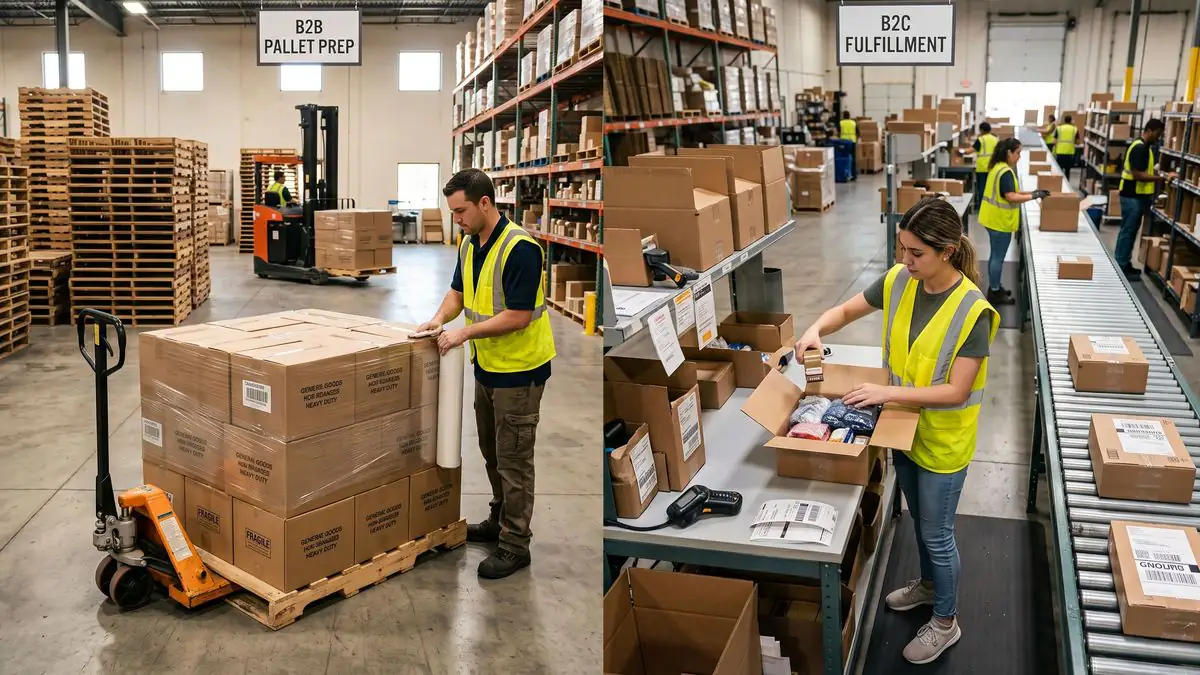
A wholesale order for 500 units lands at the same time as a single-item ecommerce order. Both may draw from the same inventory, but from that point on, their paths can look very different.
The wholesale shipment may need to follow customer-specific routing, labeling, or delivery requirements. The ecommerce order has a different promise to keep: get the right product to the shopper when expected, with clear tracking along the way.
For retailers serving both markets, the challenge is not simply handling two types of customers. It is building fulfillment processes that can meet different order requirements while keeping the wider operation connected.
What is the difference between B2B and B2C fulfillment?
B2B fulfillment handles orders sold from one business to another and often involves larger quantities, customer-specific requirements, and scheduled deliveries. B2C fulfillment ships orders directly to consumers and usually handles more individual parcels. Retailers serving both need workflows that match each order without losing visibility across inventory and operations.
B2B versus B2C fulfillment at a glance
- B2B and B2C fulfillment often require different picking, packing, shipping, and documentation processes.
- Order size alone does not define the difference. Small B2B orders may ship by parcel, while some B2C products require heavy or specialized handling.
- A retailer can use different fulfillment workflows while keeping shared visibility across orders and inventory.
- Businesses that draw B2B and B2C orders from the same stock need clear rules for reserving and allocating inventory.
- The right setup depends on the retailer’s products, customers, sales channels and service commitments rather than the B2B or B2C label alone.
What is B2B fulfillment?
Business-to-business (B2B) fulfillment is the process of preparing and shipping orders from one business to another. For a retail brand, that could mean supplying department stores, independent retailers, or other wholesale customers.
B2B orders are often larger than direct-to-consumer orders, but quantity is only part of the difference. Business customers may set specific fulfillment requirements. These can affect everything from packaging to delivery documentation.
Some trading partners use electronic data interchange (EDI) to exchange documents such as purchase orders and invoices. They may also require an advance shipping notice (ASN), specific shipping labels, or delivery appointments.
These requirements make accuracy important beyond the contents of the shipment itself. A correctly picked order can still create problems if it does not meet the customer’s agreed-upon receiving requirements.
What is B2C fulfillment?
Business-to-consumer (B2C) fulfillment covers orders shipped from a business directly to an individual customer. Ecommerce orders placed through a retailer’s website or marketplace storefront are common examples.
These operations often process a larger number of smaller orders than B2B fulfillment. Instead of preparing pallets or cases for one customer, warehouse teams may pick and pack many individual orders throughout the day.
The customer-facing delivery experience also plays a larger role. Shoppers expect clear order information and tracking, along with delivery that matches the promise made at checkout.
B2C fulfillment can become especially demanding when order volumes rise quickly during promotions or seasonal peaks.
B2B fulfillment versus B2C fulfillment
The differences below are common patterns rather than fixed rules. The exact workflow depends on the products being shipped and the requirements attached to each order.
| Consideration | B2B fulfillment | B2C fulfillment | What it means operationally |
| Order profile | Often larger case, carton or pallet orders | Often individual items or smaller parcels | Picking and packing processes may need different rules |
| Order frequency | May involve fewer, higher-volume orders | May involve a larger number of individual orders | Labor planning and warehouse capacity can differ |
| Shipping | Freight, parcel or scheduled commercial delivery may be used | Parcel carriers are common | Carrier selection should follow shipment requirements rather than buyer type alone |
| Customer requirements | May include routing guides, EDI, ASNs or customer-specific labels | Usually focused on accurate delivery information and the consumer experience | Systems need to identify and apply the requirements attached to each order |
| Inventory commitments | Wholesale orders may reserve significant quantities at once | Inventory can be sold one unit at a time across digital channels | Shared stock requires clear allocation rules |
| Returns | Often governed by commercial agreements and customer policies | Frequently initiated by individual consumers | Reverse logistics may require separate processes |
| Financial workflow | Often connected to purchase orders, invoices and payment terms | Often tied directly to the ecommerce transaction | Fulfillment data may need to support different financial processes |
7 considerations when managing B2B and B2C fulfillment
1. Start with the order profile, not the customer label
It is easy to assume that B2B means pallets and B2C means parcels. That distinction works as a general starting point, but it does not cover every order.
A retailer might ship a small wholesale replenishment order through a parcel carrier. A direct-to-consumer business selling furniture or fitness equipment can deal with large, heavy shipments.
Before designing separate workflows, look at what actually moves through the operation. Start with the shipment itself, then account for any special handling or delivery commitments.
This prevents teams from building processes around assumptions that do not match how the business sells.
2. Decide how inventory will be shared
Retailers selling to both businesses and consumers may use the same SKUs across wholesale, ecommerce, marketplaces, and stores.
That can improve flexibility, but it also creates competition for stock.
Suppose a sales team accepts a large wholesale order while the ecommerce site continues offering the same units to consumers. Without clear inventory rules, the retailer can commit more stock than it can fulfill.
Three separate decisions matter here:
- Visibility: Can teams see how much inventory is available and where it is located?
- Pooling: Can multiple channels sell from the same physical stock?
- Allocation: How much stock should be reserved for a specific customer, channel, or existing commitment?
These do not have to produce the same answer. A retailer can maintain visibility across all inventory while reserving some units for wholesale accounts or other priorities.
3. Account for B2B compliance requirements
A B2B order may need to meet requirements set by the receiving business. The exact rules depend on the customer.
For some trading relationships, the process may include EDI documents, an ASN, or customer-specific shipping labels. Large retail customers may also specify how goods should be packaged or routed through their receiving network.
Missing one of these requirements can create receiving delays and, depending on the commercial agreement, deductions or other costs.
Retailers growing their wholesale operations should document customer requirements and ensure the correct rules apply throughout the order fulfillment process. Relying on warehouse employees to remember each account’s requirements manually becomes harder as the customer base grows.
4. Decide whether different workflows need different infrastructure
B2B and B2C workflows do not automatically require separate warehouses.
One facility may be able to handle both. Warehouse teams could pick individual ecommerce orders in one workflow while preparing case or pallet orders through another.
For other retailers, separation may make more sense. Some products need specialized handling. Customer agreements or geographic coverage may also justify using a different facility or fulfillment partner.
The same distinction applies to inventory. Maintaining one view of stock does not mean every unit needs to sit in one building or remain available to every channel.
The goal is to separate processes where specialization helps without creating unnecessary information gaps between them.
5. Match shipping decisions to the service promise
B2C delivery is often associated with speed, but speed should not be the only consideration.
A retailer needs to deliver within the timeframe promised to the customer at a cost the order can support. Faster shipping that erodes the margin on every sale is not automatically a better fulfillment strategy.
B2B orders introduce a different set of delivery constraints. A wholesale customer may require goods on a particular date or within an agreed receiving window because its own operations depend on that stock arriving as planned.
For both models, the same question applies: What delivery commitment has been made, and what process gives the retailer the best chance of meeting it consistently?
6. Plan for different returns processes
B2C returns often begin with an individual shopper sending an item back. Retailers need a process for receiving the product, assessing its condition, and determining what to do with the inventory next.
B2B returns can follow different commercial rules. A wholesale customer may report damaged goods, shipping discrepancies, or products covered by an agreed return arrangement.
Trying to force both through an identical process can make returns harder to track.
Retailers should define who approves each type of return and how returned stock is recorded. This helps protect inventory accuracy and gives finance teams better information about what happened to the order.
7. Consider the financial workflow behind the shipment
Fulfillment does not end when a carrier collects the order.
B2B transactions may involve purchase orders, invoices, and payment terms that continue after goods have shipped. If the shipment does not match the purchase order or the customer reports a compliance issue, the problem can affect both financial records and warehouse operations.
B2C orders tend to follow a different payment flow because consumers generally pay at the time of purchase.
For retailers serving both markets, order, fulfillment, and financial information need to remain consistent. Otherwise, teams can spend time reconciling disconnected records just to determine whether the order and its financial record match.
Should you manage B2B and B2C fulfillment in-house or outsource it?
Businesses commonly choose among three broad approaches:
- In-house fulfillment gives the retailer direct control over its warehouse processes but requires internal capacity and expertise.
- Outsourced fulfillment can provide access to warehouse infrastructure and specialist capabilities without building everything internally.
- A hybrid model divides fulfillment between internal teams and outside partners based on channel, geography, or operational requirements.
There is no single model that works best for every growing retailer. Volume, product characteristics, and service commitments should drive the decision.
How retail operations software supports B2B and B2C fulfillment
Managing two fulfillment models becomes harder when sales channels and operational systems hold different versions of order or inventory information.
Retail operations software can give teams a common view of orders and inventory while still allowing different fulfillment processes to operate where needed.
Automation can also apply defined rules to repetitive order workflows. For example, the process can identify which orders require a particular fulfillment path rather than relying on employees to make the same routing decision manually each time.
The important distinction is that software does not determine what the fulfillment strategy should be. Retailers first need clear rules for how orders, inventory, and exceptions should be handled. The system can then help teams apply those rules consistently as order volumes grow.
Managing B2B and B2C fulfillment with Brightpearl
Brightpearl’s Retail Operating System connects order management, inventory visibility, fulfillment workflows, purchasing, and financial management for retail and ecommerce businesses.
For retailers selling through B2B and B2C channels, this connected view can help teams manage channel-specific order requirements without losing sight of what is happening across the wider operation.
Brightpearl also supports retail operations automation, helping businesses reduce repetitive manual work as order volumes and sales channels grow.
Rather than treating fulfillment as an isolated warehouse function, retailers can connect it with the inventory, order, and financial information that teams use to manage the business.
Book a demo to see how Brightpearl can help you manage retail operations across multiple sales and fulfillment channels.
Questions to ask before changing your fulfillment model
Before separating or combining B2B and B2C fulfillment, review how the operation works today.
| Question | Why it matters |
| Do B2B and B2C orders use the same SKUs? | Significant overlap makes inventory allocation and visibility more important. |
| Which customers impose specific shipping or compliance requirements? | These requirements may justify separate workflows. |
| Are current warehouse processes handling both order profiles efficiently? | Existing capacity may support both models without adding separate infrastructure. |
| Where do order or inventory errors occur today? | The answer can reveal whether the issue comes from warehouse execution, data gaps or unclear processes. |
| Do outside fulfillment partners need access to the same operational information? | Outsourcing physical fulfillment does not remove the need for accurate order and inventory data. |
FAQ: Managing B2B and B2C fulfillment operations
Does every B2B business need EDI?
No. EDI requirements depend on the trading partners a business works with. Some large retailers require suppliers to exchange documents electronically, while smaller wholesale customers may use other ordering and invoicing processes. Businesses should confirm each customer’s requirements rather than assuming EDI applies to every B2B order.
Can the same 3PL handle B2B and B2C fulfillment?
Yes, if the provider can support the requirements of both order types. A retailer should confirm that the 3PL can handle its actual order profiles and customer requirements, rather than choosing a provider solely because it advertises both services.
Is B2B fulfillment cheaper than B2C fulfillment?
Not necessarily. B2B can reduce the number of individual shipments by moving more units in each order, but freight, customer requirements, and compliance failures can add costs. B2C involves different expenses, including individual parcel shipping and returns. Retailers should compare fulfillment cost against the economics of each channel rather than assuming one model is cheaper.
Build fulfillment around the requirements of the order
The difference between B2B fulfillment vs. B2C fulfillment matters, but the label alone should not determine how a retailer builds its operation.
B2B and B2C orders can follow separate workflows while still sharing inventory visibility, operational data, or physical infrastructure. The right balance depends on what the business sells, what customers require, and how its fulfillment operation is structured.
As retail businesses add channels and customers, keeping those decisions connected becomes increasingly important. Brightpearl gives retailers one operating system for managing orders, inventory, fulfillment, and financial workflows as the business grows.
Book a demo to learn how Brightpearl can support your retail operations.