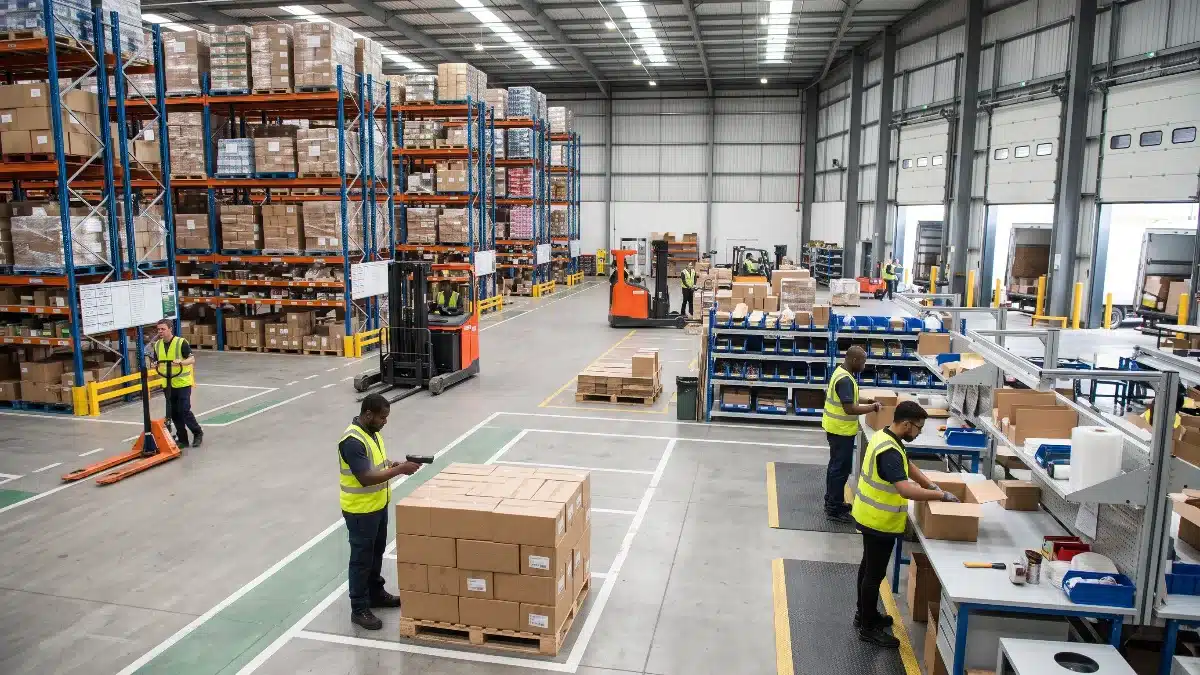
As order volumes rise and sales channels multiply, small warehouse inefficiencies start to add up. Unnecessary stock movements, disorganized storage, manual processes, and fulfillment errors increase operating costs and slow orders down.
Lean warehouse management gives retailers a practical way to identify waste and improve how inventory moves from receiving through shipping. Applying lean principles to everyday processes, targeting specific inefficiencies, and measuring results helps turn small changes into lasting operational gains.
Key Takeaways
- Lean warehouse management helps retailers identify and remove unnecessary activities across receiving, storage, picking, packing, and fulfillment.
- The 5S methodology supports organized workspaces, standardized processes, and continuous improvement.
- Common sources of waste include unnecessary inventory movement, excess stock, processing delays, and fulfillment errors.
- Better layouts, standardized workflows, accurate inventory tracking, and employee involvement all improve warehouse efficiency.
- KPIs, warehouse management software, and automation help retailers measure progress, reduce manual tasks, and sustain gains.
What Is Lean Warehouse Management?
Lean warehouse management is an approach to running warehouse operations that focuses on eliminating waste, improving workflows, and maximizing the value of activities that support customers.
In a retail warehouse, lean principles apply to receiving, putaway, storage, inventory tracking, picking, packing, and shipping. The aim is to keep inventory and information flowing smoothly, cut unnecessary handling, and align warehouse activity with customer demand. Lean is not a one-time project. Teams regularly identify inefficiencies, test improvements, and refine processes as the business changes.
The 5S Principles of Lean Warehouse Management
The 5S methodology is a lean workplace organization technique that helps warehouse teams maintain an orderly, efficient, and consistent work environment. Each step builds on the last: clearing out what is not needed makes the remaining items easier to organize, and organized spaces are easier to maintain and standardize.
Together, the five steps lay the groundwork for broader waste reduction and continuous improvement.
- Sort: Remove unnecessary materials, equipment, and packaging from workspaces.
- Set in Order: Arrange inventory, tools, and workstations so frequently used items are easy to reach.
- Shine: Keep work areas clean and safe, and inspect equipment regularly.
- Standardize: Establish consistent procedures for receiving, inventory handling, picking, and packing.
- Sustain: Reinforce improvements through regular audits, training, and process reviews.
5S works best as an ongoing routine rather than a one-off cleanup. Many retailers start with a single area, such as the packing station or a high-traffic picking aisle, and then extend the approach across the warehouse once the results are clear.
Common Types of Waste in Warehouse Operations
Lean management traditionally groups waste into seven categories, each representing time, effort, space, or money spent on activities that add no value for customers. In a growing retail warehouse, these problems often build gradually as order volumes rise, product ranges expand, and new sales channels come online, which makes them easy to overlook.
The seven categories give retailers a practical checklist for uncovering inefficiencies.
- Transportation: Moving inventory unnecessarily between receiving areas, storage locations, or workstations. Poor storage arrangements, for example, can mean products are transferred repeatedly between zones.
- Excess inventory: Holding more stock than needed, which takes up space and ties up working capital. Seasonal products and slow-moving SKUs often occupy valuable locations long after demand has dropped.
- Unnecessary motion: Employees walking long distances, searching for products, or following inefficient picking routes. Storing frequently ordered items far from packing stations is a common cause.
- Waiting: Delays caused by unavailable inventory, missing order information, equipment downtime, or poorly coordinated workflows. Fulfillment teams may sit idle while waiting for replenishment.
- Overprocessing: Extra handling, repeated checks, or duplicate data entry that add little value. Manually reentering order details between disconnected inventory and shipping systems is a typical example.
- Overproduction: Preparing inventory beyond actual requirements, such as prepacking too many promotional bundles that later need to be stored or broken down. Preparing orders in advance is not wasteful when it supports genuine demand.
- Defects: Incorrect picks, damaged products, shipping errors, and inaccurate inventory records that require rework. Shipping the wrong product variation, for instance, creates extra returns processing.
Many of these forms of waste are connected. Poor product placement, for example, can lead to unnecessary motion, longer waits at packing stations, and more picking errors. Pinpointing where waste occurs, and tracing it back to its root cause, is the first step toward improving warehouse performance.
Benefits of Lean Warehouse Management for Retailers
The benefits of lean warehouse management come from specific operational changes rather than general efficiency gains. When retailers remove a particular source of waste, the improvement usually shows up in a measurable business outcome.
- Lower operating costs: Fewer unnecessary stock movements, less repeated handling, and less manual processing help control warehouse expenses.
- Faster order fulfillment: Better picking routes and fewer workflow steps shorten order processing times.
- Improved inventory accuracy: Standardized receiving, stock tracking, and counting reduce discrepancies.
- Better space utilization: Removing clutter and placing products by demand makes better use of storage capacity.
- Greater customer satisfaction: Accurate picking, reliable availability, and timely shipping support a better delivery experience.
These benefits tend to reinforce one another. More accurate inventory reduces picking errors; fewer errors mean fewer returns, and less rework frees up time and space for fulfilling new orders.
How to Implement Lean Warehouse Management
Lean implementation works best as a series of targeted improvements rather than a full overhaul. Retailers that pinpoint specific inefficiencies, fix them, measure the results, and then expand what works tend to see steadier, longer-lasting gains.
1. Evaluate Existing Warehouse Workflows
Start by reviewing how inventory and information move through receiving, putaway, storage, picking, packing, shipping, and returns. Look for delays, unnecessary movement, repeated handling, and recurring errors. Value stream mapping can help teams visualize each workflow and spot activities that add no value.
Record baseline measurements such as fulfillment times, picking accuracy, or inventory discrepancies. Then choose one high-impact process for an initial improvement project, rather than changing everything at once.
2. Optimize Warehouse Layout and Product Placement
Organize storage locations around product demand, picking frequency, and accessibility. Placing fast-moving products near picking and packing areas cuts travel time, while zoning, clear signage, and accessible workstations make the space easier to navigate.
A retailer might reorganize high-demand products ahead of a seasonal sales peak or separate frequently picked SKUs from slow-moving inventory. Changes like these reduce unnecessary movement, shorten picking times, and free up storage space.
3. Standardize Receiving and Putaway Processes
Set consistent procedures for inspecting, recording, labeling, and storing incoming inventory. Clearly defined storage locations and accurate product records reduce misplaced stock, and barcode scanning helps validate received quantities and putaway locations.
A common inefficiency is the gap between goods arriving and becoming available for fulfillment. Standardized receiving shortens dock-to-stock times, improves inventory accuracy, and prevents downstream problems.
4. Streamline Picking, Packing, and Shipping
Review fulfillment processes for unnecessary movement, repeated tasks, and processing delays. Depending on order volumes and layout, batch, wave, or zone picking can reduce travel and speed up order preparation. Standardized packing procedures and order verification help catch mistakes before shipment.
Connected order processing and shipping workflows reduce manual handoffs. For example, a retailer selling through a webstore and online marketplaces can route all orders into a single fulfillment queue, avoiding duplicated work and delays caused by checking separate channel dashboards.
5. Improve Inventory Accuracy and Stock Control
Track every stock movement, transfer, return, and adjustment to keep records accurate. Regular cycle counts reveal discrepancies without relying solely on full physical stocktakes. Reviewing slow-moving and excess inventory also highlights opportunities to reclaim storage space.
Consistent returns processing matters, too: inspect returned items, update records, and promptly return eligible products to available stock. Lean inventory management balances efficiency with demand, particularly during seasonal peaks or periods of uncertain supply.
6. Train Employees and Encourage Continuous Improvement
Give employees clear instructions and training on standardized procedures, with consistent expectations around safety and communication across shifts. Encourage them to report inefficiencies and suggest improvements.
Continuous improvement, or Kaizen, is built on small, ongoing changes. Pickers might notice an inefficient route, test a revised product arrangement in one aisle, and confirm the results before rolling the change out across the warehouse.
7. Measure Performance and Refine Processes
Compare performance against the baseline recorded before changes were made. Assess whether the initial project reduced delays, handling, errors, or processing costs, and use employee feedback alongside the data to decide which changes to adjust, keep, or expand.
Gradually roll successful improvements out to other processes or locations. Regular performance reviews keep the warehouse improving long after the first project is complete.
Key Metrics for Measuring Lean Warehouse Performance
Measuring performance shows whether lean initiatives are actually reducing waste and improving efficiency. As with any operational metrics, results mean the most when compared against historical performance or an established baseline, rather than viewed in isolation.
- Order picking accuracy: The percentage of products or order lines picked correctly. Shows whether layout changes, scanning, and standardized procedures are reducing errors.
- Order fulfillment cycle time: How long an order takes to move from release to shipment. Reveals whether workflow changes are removing delays.
- Inventory accuracy: How closely recorded quantities and locations match physical stock. Tests the effectiveness of receiving, tracking, and cycle counts.
- Dock-to-stock time: How quickly incoming inventory is received, processed, and made available. Highlights bottlenecks in receiving and putaway.
- Warehouse labor productivity: Orders or order lines processed per labor hour. Indicates whether changes are cutting unnecessary work and movement.
- Cost per order: Warehouse operating expenses relative to fulfilled orders. Shows whether improvements are lowering processing costs.
- Warehouse space utilization: How effectively available storage capacity is used. Points to opportunities to improve product placement and reduce excess stock.
Tracking a manageable set of KPIs keeps reviews focused. Productivity gains should always be weighed against accuracy, customer service, and employee safety.
How Warehouse Management Software Supports Lean Operations
Warehouse management software helps retailers put lean practices in place and keep them there. Paper pick lists, spreadsheet stock records, and rekeying orders between systems create many of the delays and errors that lean management aims to remove. The right software reduces that manual work, improves inventory visibility, and supports standardized workflows.
- Real-time inventory tracking: Keeps stock records accurate as products are received, moved, picked, shipped, and returned.
- Barcode scanning: Validates stock movements, received quantities, and picked items, reducing errors and duplicate data entry.
- Automated workflows: Removes repetitive tasks and delays between receiving, inventory management, and fulfillment.
- Picking and packing optimization: Supports organized picking strategies, order verification, and efficient shipment preparation.
- Connected inventory and order management: Keeps warehouse activity in sync with sales channels, purchasing, and fulfillment.
- Warehouse reporting: Tracks accuracy, processing times, and performance to surface improvement opportunities.
Software supports lean principles but cannot replace effective workflows, trained employees, and a commitment to continuous improvement. Retailers get the most value when they streamline a process first and then use technology to make it faster and more consistent. Connecting warehouse operations to the wider business through a retail ERP extends those gains, helping retailers manage inventory, orders, and fulfillment from one system.
Streamline Warehouse Operations With Brightpearl
Lean warehouse management depends on efficient processes, reliable inventory information, and coordinated workflows. Growing retailers need technology that connects the warehouse with purchasing, order management, fulfillment, and finance. Brightpearl’s retail ERP is built for growing multichannel retailers, bringing these functions together in one system.
Brightpearl provides real-time inventory visibility across channels and warehouse locations. It supports barcode-driven receiving, guided putaway, inventory movements, and stock counts, and it streamlines picking, packing, shipping, and returns. Automation handles repetitive order processing and fulfillment tasks, while warehouse activity stays coordinated with purchasing and order management. Operational reporting helps teams spot opportunities for improvement. The result is less manual work, better inventory accuracy, more efficient fulfillment, and greater operational control.
Book a demo to see how Brightpearl’s connected warehouse management and retail ERP capabilities can support leaner operations.
Frequently Asked Questions
What is the difference between lean warehousing and traditional warehouse management?
Traditional warehouse management focuses on coordinating inventory storage, handling, and fulfillment. Lean warehouse management adds a continuous improvement approach that identifies and eliminates inefficiencies within those activities, helping retailers evaluate existing workflows and make measurable improvements.
Does lean warehouse management require automation?
No. Retailers can apply lean principles through better organization, standardized processes, employee training, and regular performance reviews. Warehouse automation and management software can help maintain and scale those improvements by reducing repetitive tasks, improving inventory visibility, and supporting consistent workflows.
How can retailers balance lean inventory practices with stock availability?
Reducing excess inventory should never come at the expense of availability or customer satisfaction. Accurate demand forecasting, inventory tracking, replenishment planning, and appropriate safety stock help strike the right balance. Seasonal demand, supplier lead times, and multiple sales channels all affect how much stock is needed. Lean inventory management focuses on cutting unnecessary stock and handling while keeping enough on hand to meet demand.